Macy’s is one of the most recognizable names in American retail, with a history that stretches back more than 165 years. Founded as a modest dry-goods store in New York City, it grew into a national department-store chain synonymous with holiday shopping, grand flagship locations, and the annual Macy’s Thanksgiving Day Parade.
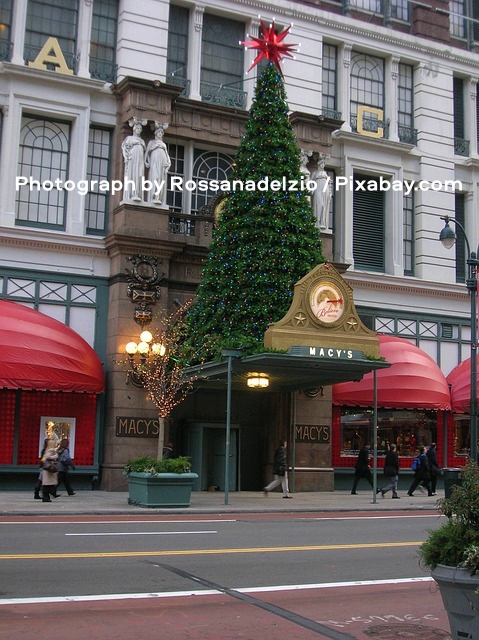
The photograph above shows the iconic Macy’s department store facade at street level, dominated by a towering Christmas tree covered in lights and topped with a large red star, positioned directly in front of the entrance under a gold-trimmed canopy bearing the store’s name. The building features classical stone architecture with tall windows, decorative statues in niches, red awnings over the ground-floor displays, and illuminated signage, while pedestrians stroll along the sidewalk and a city street with painted markings fills the foreground. Image by Rossanadelzio / Pixabay.Com.
Origins and early growth
Rowland Hussey Macy was born on August 30, 1822, on Nantucket Island, Massachusetts, into a Quaker family. He was the fourth of six children. After working as a printer’s apprentice in Boston, he tried several retail ventures that failed, including stores in Haverhill, Massachusetts, and Marysville, California. In 1858 he opened R.H. Macy & Co. on the corner of 14th Street and Sixth Avenue in New York City. The store’s first-day sales totaled just over $11. Macy adopted a red star as his logo, a mark still used by the company today. He married Louisa Houghton in 1844; the couple had three children.
The business expanded steadily under Macy’s leadership through innovative practices such as fixed prices, newspaper advertising, and a money-back guarantee. After his death in 1877, the Straus family gradually took control and achieved full ownership by 1896. In 1902 the store moved to its present Herald Square location at Broadway and 34th Street. Subsequent expansions created what was long billed as the world’s largest store, eventually covering roughly 2.2 million square feet.
National expansion and corporate consolidation
Throughout the 20th century Macy’s grew through acquisitions and the conversion of regional department-store chains. In 1992 the company filed for Chapter 11 bankruptcy protection. Two years later it was acquired by Federated Department Stores. In 2005 Federated purchased The May Department Stores Company in a major deal; by 2006 most of May’s regional nameplates had been converted to Macy’s. In 2007 Federated itself was renamed Macy’s, Inc. The parent company also owns the upscale Bloomingdale’s chain and the beauty specialty retailer Bluemercury.
Cultural landmarks
The Macy’s Thanksgiving Day Parade, first held in 1924 as the Macy’s Christmas Parade to celebrate the expanded Herald Square store and kick off the holiday shopping season, has become one of the country’s best-known public events. Early parades featured live animals, floats, and Santa Claus; giant character balloons were introduced in 1927. The parade was suspended only during World War II. Its cultural status was further reinforced by the 1947 film Miracle on 34th Street, which centered on the store and the question of whether its Santa was genuine.
The Herald Square flagship remains a major tourist destination, known for its scale, holiday windows, and the parade’s traditional ending point.
Recent challenges and strategy
Like many traditional department stores, Macy’s has faced pressure from e-commerce, changing consumer habits, and competition from both discounters and specialty retailers. In recent years the company has closed underperforming locations while investing in a smaller core of “reimagined” stores with improved staffing, merchandising, and customer experience. As of late 2026 the Macy’s nameplate operated in the low-to-mid 400s of stores, with a longer-term plan to concentrate on roughly 350 go-forward locations. Trailing twelve-month revenue has been in the low-to-mid $22 billion range. Tony Spring has served as chief executive since early 2024, overseeing the company’s “Bold New Chapter” strategy.
Macy’s continues to balance its historic role as a national retail institution with the practical demands of a rapidly changing industry.