
Charadriiformes (/kəˈrædri.ɪfɔːrmiːz/), named from Charadrius, the type genus of the plover family Charadriidae, is a diverse order of small to medium-large birds. It comprises about 392 species in 19 families and occurs on every continent. Most members live near water and feed on invertebrates or other small animals, but the group is more varied than that label suggests: some species are pelagic seabirds, others inhabit deserts, and a few, such as woodcocks, live in woodland and forest. The order as a whole is sometimes called the shorebirds, though that name is more often reserved for the wading species.
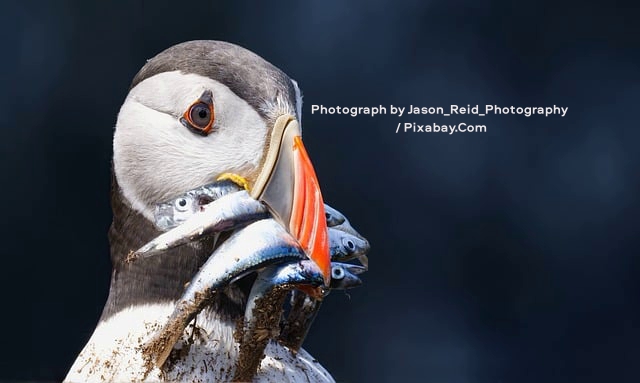
the photograph above captures a close-up of an Atlantic Puffin (Fratercula arctica) in profile against a dark, softly blurred background. The bird’s white face and dark crown frame a striking, brightly colored beak of orange, yellow and gray, and its alert orange-ringed eye looks toward the viewer. Several slender, silvery fish hang from the sides of the beak, their bodies overlapping as if freshly caught. Fine specks of sand or dirt cling to the bird’s black-and-white plumage, adding a sense of recent activity on the shore or cliff. Photograph by Jason_Reid_Photography / Pixabay.Com.
The order is divided into three suborders: Charadrii, Scolopaci, and Lari. Together they include birds of mudflats, open plains, freshwater wetlands, deserts, and the open ocean.
Charadrii
Charadrii are the typical shorebirds in the narrow sense: mostly visual hunters of open ground and shallow water. Many have relatively short, stout bills and large eyes, and they feed by watching for movement, then darting forward to pick prey from the surface rather than probing deep into mud. They occupy both coastal and inland habitats, from beaches and salt pans to river margins, grasslands, and arid country.
The largest family is Charadriidae, the plovers, dotterels, and lapwings (69 species). Plovers are compact waders with a characteristic run-and-pause hunting style. Lapwings are often bolder in plumage and more associated with fields and wetlands. Other families in the suborder include:
- Haematopodidae — oystercatchers (12 species), stout-billed coastal birds that pry open or hammer mollusks
- Recurvirostridae — avocets and stilts (9 species), long-legged waders; avocets sweep their upcurved bills through the water
- Burhinidae — stone-curlews or thick-knees (10 species), largely nocturnal birds of dry open country
- Chionidae — sheathbills (2 species) of the Antarctic and subantarctic, scavengers around seabird colonies
- Ibidorhynchidae — the Ibisbill (Ibidorhyncha struthersii), a single species of Himalayan and Central Asian shingle rivers, with a strongly downcurved bill
- Pluvianidae — the Egyptian Plover (Pluvianus aegyptius)
- Pluvianellidae — the Magellanic Plover (Pluvianellus socialis) of southern South America
Although most Charadrii are tied to water or damp ground, thick-knees and some plovers also occupy dry habitats.
Scolopaci
Scolopaci are the probing waders and their close relatives. Many have slender, sensitive bills used to detect prey by touch in mud, sand, or soil. Compared with plovers, they often have smaller eyes, slimmer heads, and longer bills. The suborder includes both familiar flocking shorebirds and several odd, more terrestrial families.
The dominant family is Scolopacidae, the sandpipers, snipes, woodcocks, curlews, godwits, turnstones, and phalaropes (98 species). Bill shape varies widely: short and straight in small “peeps,” long and downcurved in curlews, slightly upturned in godwits, and extremely long in snipes and woodcocks. Many species breed at high latitudes and make long migrations to coastal mudflats and inland wetlands. Phalaropes are unusual among waders in swimming readily and spinning on the water to stir up prey; in several species the female is the brighter bird and the male incubates.
The remaining families are smaller but distinctive:
- Jacanidae — jacanas (8 species), wetland birds with extremely long toes that allow them to walk on floating vegetation
- Rostratulidae — painted-snipes (3 species), secretive marsh birds; some are polyandrous
- Thinocoridae — seedsnipes (4 species) of Andean and Patagonian open country, more like small gamebirds than typical waders
- Pedionomidae — the Plains-wanderer (Pedionomus torquatus), a rare, quail-like bird of Australian grasslands
Scolopaci therefore range from Arctic-breeding migrants packed onto tidal flats to cryptic birds of marshes, woodland floors, and dry plains.
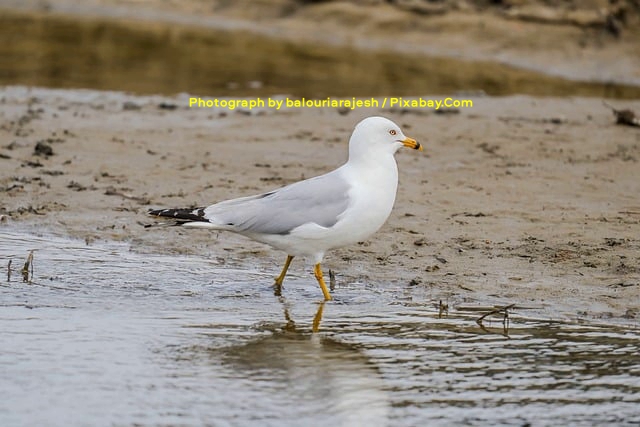
the photograph above captures a Ring-billed Gull (Larus delawarensis) standing in the shallow water of a sandy beach shoreline, its white head and body contrasting with pale gray wings that darken to black at the tips, a yellow beak marked by a small red spot near the end, and matching yellow legs as it appears mid-stride with one foot lifted, the wet sand and calm water reflecting its form while scattered debris dots the background. Photograph by balouriarajesh / Pixabay.Com.
Lari
Lari are the gulls and their allies: generally larger, longer-winged birds, many of them associated with the sea. Most have webbed feet. Typical members take fish and other animal prey from water or shore, but the suborder also includes inland and even terrestrial specialists.
Laridae is the largest family, with gulls, terns, and skimmers (105 species). Gulls are versatile foragers and scavengers, equally at home on coasts, lakes, farmland, and cities. Terns are slimmer and more aerial, plunging or dipping for fish. Skimmers fly low over water and use an elongated lower mandible to snap up prey at the surface. Stercorariidae, the skuas and jaegers (7 species), are powerful predators and kleptoparasites that rob other seabirds and also take fish, eggs, chicks, and small vertebrates.
Two further marine families complete the classic “seabird” side of the group:
- Alcidae — auks, murres, guillemots, and puffins (25 species), Northern Hemisphere divers that “fly” underwater after fish; they have stout bodies and short wings suited to pursuit diving
- Dromadidae — the Crab-Plover (Dromas ardeola), a black-and-white coastal bird of the Indian Ocean that feeds on crabs and nests in burrows
Lari also includes less obviously marine families. Glareolidae, the coursers and pratincoles (17 species), are open-country birds: coursers run after insects on dry ground, while pratincoles catch prey on the wing like small terns. Turnicidae, the buttonquails (18 species), are small, secretive, quail-like birds of grassland and scrub.
Taken together, the three suborders account for the breadth of Charadriiformes: visual surface-feeders on open shores and plains, tactile probers of mud and marsh, and gull-like birds of coasts, the open sea, and, in a few cases, dry land.