
On July 4, 2026, the United States celebrates a historic milestone: the 250th anniversary of the signing of the Declaration of Independence. What began as 13 colonies declaring their break from British rule in 1776 has evolved into a vibrant, diverse nation of over 340 million people. This “Semiquincentennial” (or “America250”) is the biggest national birthday party since the 1976 Bicentennial, blending spectacular public events, historical reflection, and community gatherings from coast to coast.
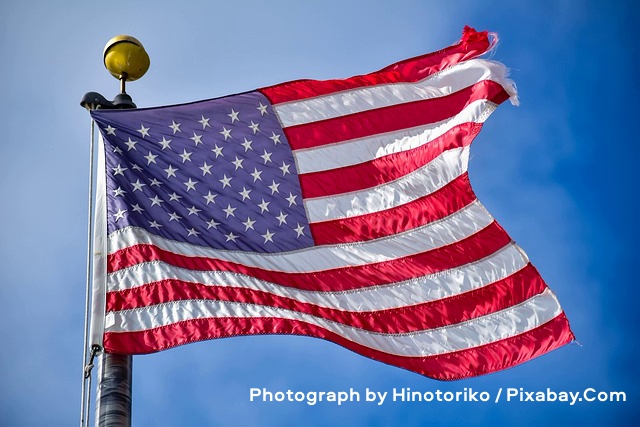
The photograph above features the American flag billowing vigorously in the wind on a tall metal flagpole against a clear bright blue sky with faint clouds. The iconic design shows the blue canton filled with white stars in the upper left corner and alternating red and white horizontal stripes rippling dynamically across the fabric, which appears slightly tattered at the flying edge, while a golden spherical finial crowns the pole on the left side of the frame.
Photograph by Hinotoriko / Pixabay.Com.
Today is not just another Independence Day—it’s a quarter-millennium marker. The day evokes the bold words penned primarily by Thomas Jefferson and adopted by the Continental Congress in Philadelphia: that all men are created equal, endowed with unalienable rights to life, liberty, and the pursuit of happiness.
How America gained its independence
The path to independence was neither quick nor easy. Tensions between the American colonies and Great Britain had been building for years, fueled by Britain’s efforts to tighten control and raise revenue after the costly French and Indian War (1754–1763). New taxes—such as the Stamp Act of 1765, the Townshend Acts, and the Tea Act of 1773—were imposed without colonial representation in Parliament, prompting the famous rallying cry of “No taxation without representation.”
Protests escalated dramatically. The Boston Massacre in 1770 and the Boston Tea Party in 1773 deepened the rift. In response, Britain passed the Coercive (or “Intolerable”) Acts in 1774, which further inflamed colonial resistance. The First Continental Congress met that same year to coordinate opposition, followed by the outbreak of armed conflict at the Battles of Lexington and Concord on April 19, 1775—the “shot heard round the world.”
By 1776, the Second Continental Congress had created the Continental Army under George Washington’s command and moved toward a formal break. On July 4, 1776, the delegates adopted the Declaration of Independence, drafted chiefly by Thomas Jefferson, asserting the colonies’ right to self-government and listing grievances against King George III. The Revolutionary War that followed was long and brutal, marked by key victories such as the Battle of Saratoga in 1777 (which secured crucial French military and financial support) and the decisive Siege of Yorktown in 1781, where British General Cornwallis surrendered.
The conflict officially ended with the Treaty of Paris in 1783, in which Britain formally recognized the independence of the United States. The new nation then navigated the challenges of self-rule, first under the Articles of Confederation and later with the stronger framework of the U.S. Constitution, ratified in 1788 and implemented in 1789.
A year of celebrations culminating on July 4
Preparations for this milestone have spanned years, led by the congressionally authorized U.S. Semiquincentennial Commission (branded America250) and complemented by the White House’s Freedom 250 initiative. The goal? Engage “350 for 250”—reaching all Americans through service, storytelling, volunteering, and local events.
Highlights include:
- Washington, D.C.: The centerpiece is “Salute to America 250” on the National Mall. Crowds gather for military flyovers, performances, storytelling of American heroes, and remarks by President Donald Trump. The evening features what organizers describe as one of the largest fireworks displays in history, illuminating the Washington Monument, Lincoln Memorial, and Capitol.
- New York Harbor: Sail250 brought an international fleet of tall ships—echoing the iconic 1976 Operation Sail—for parades past the Statue of Liberty, alongside naval reviews. A special Times Square ball drop on July 3 kicked off the holiday weekend with patriotic flair.
- Philadelphia: The birthplace of the Declaration hosts the burial of a national time capsule at Independence Mall (to be opened in 2276 for the nation’s 500th anniversary), alongside ceremonies at Independence Hall and historical reenactments.
- Nationwide and Local: From Boston’s Esplanade fireworks and “A Capitol Fourth” concert on PBS, to Chicago’s Navy Pier display, Los Angeles’ star-studded block party at the Coliseum (featuring artists like Chris Stapleton, The Smashing Pumpkins, and others), and countless community parades, barbecues, and “America’s Block Party” events. Naturalization ceremonies welcome new citizens at historic sites like Mount Vernon.
A record heat wave has impacted some outdoor plans (certain parades were adjusted or canceled for safety), but the spirit remains strong as millions gather despite the summer swelter.
More than fireworks: reflection on 250 years
This anniversary invites Americans to look back and forward. The nation has endured revolution, civil war, world wars, civil rights struggles, technological revolutions, and profound social change. It has welcomed immigrants, innovated at unprecedented scale, and become a global leader in democracy, culture, science, and opportunity.
Events emphasize unity amid diversity: flag-waving campaigns (“America Waves”), oral history projects, service initiatives (“America Gives”), and educational programs highlighting contributions from all communities.
As one observer noted, it’s a chance to honor the “triumph of the American spirit” while acknowledging the ongoing work of perfecting the union.
Looking ahead
The Semiquincentennial isn’t an endpoint but a launchpad. Organizers hope the celebrations leave lasting legacies—restored historic sites, new civic infrastructure, stronger community bonds, and renewed appreciation for founding principles of liberty and self-government.
From small-town parades to massive spectacles on the National Mall, the message is clear: America at 250 is a story still being written. It’s a story of resilience, reinvention, and the enduring promise that here, more than anywhere, people can pursue their dreams.
Happy 250th Birthday, America. May the next 250 years be even brighter. 🇺🇸
As the skies light up with fireworks and communities come together across time zones, one truth endures: the American experiment continues—bold, imperfect, and full of promise.