
FIFA, the Fédération Internationale de Football Association, stands as the global governing body of association football, also widely known as soccer. It organizes the FIFA World Cup, sets the Laws of the Game (in collaboration with IFAB), oversees international transfers, promotes development at all levels, and represents 211 national member associations across six continental confederations.
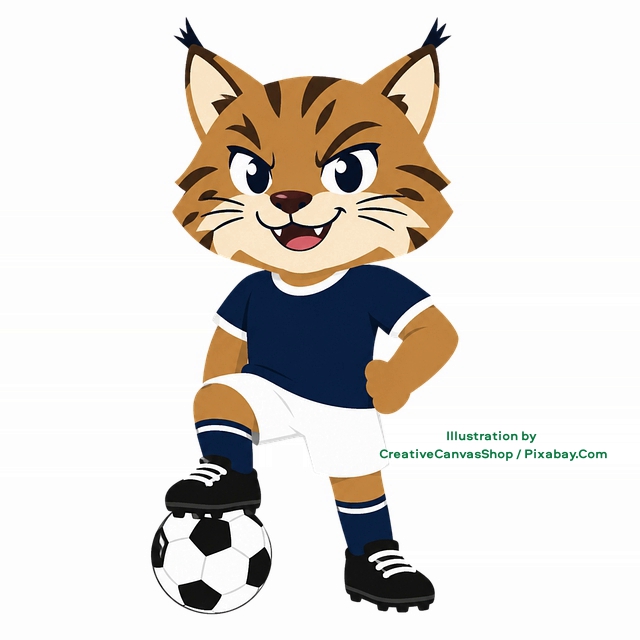
the illustration above depicts a cheerful cartoon wildcat mascot standing in an athletic soccer pose on a plain white background, with its right foot resting atop a black-and-white soccer ball and its left hand placed confidently on its hip, the character has brown fur accented with darker stripes across its face and body, large pointed ears tipped with black tufts, wide sparkling blue eyes, prominent whiskers, and an open smiling mouth revealing teeth and a pink tongue, while dressed in a short-sleeved navy blue jersey with white collar and cuff trim, white shorts, navy blue socks featuring white and brown stripes, and black soccer cleats with visible studs. Illustration by CreativeCanvasShop / Pixabay.Com.
Its journey from a small European initiative in 1904 to a multibillion-dollar organization shaping the world’s most popular sport reflects football’s (or soccer’s) explosive global growth.
Founding and early years (1904–1930)
FIFA was founded on 21 May 1904 in Paris, France, at the headquarters of the Union des Sociétés Françaises de Sports Athlétiques. Representatives from seven European associations—Belgium, Denmark, France, the Netherlands, Spain, Sweden, and Switzerland—established the organization to standardize rules and oversee international matches. Germany joined the same day via telegram.
Robert Guérin, a French journalist, became the first president (1904–1906). England joined in 1906, and Daniel Burley Woolfall (England) served as president from 1906 until his death in 1918. Under early leadership, FIFA standardized the Laws of the Game and organized football at the 1908 and 1912 Olympic Games.
Membership expanded beyond Europe: South Africa joined in 1909, followed by Argentina and Chile (1912), and the United States and Canada (1913). World War I disrupted activities, but Dutch official Carl Hirschmann kept FIFA alive. The British Home Nations withdrew temporarily over political issues but rejoined later.
The birth of the world cup and interwar growth
Jules Rimet (France), president from 1921 to 1954 (FIFA’s longest-serving leader), drove the vision for a standalone global tournament independent of the Olympics, which restricted professionals.
At the 1928 FIFA Congress, plans advanced for the first FIFA World Cup, awarded to Uruguay in 1930 to mark its centenary of independence. Only 13 teams participated (four from Europe due to long travel), with Uruguay defeating Argentina 4–2 in the final.
Subsequent tournaments in Italy (1934) and France (1938) grew the event’s prestige. World War II halted the competition (1942 and 1946 cancelled). The British associations fully rejoined in 1946.
Post-war expansion, commercialization, and global reach
Post-1945, FIFA grew rapidly. Membership reached 84 by its 50th anniversary in 1954. Presidents like Stanley Rous (1961–1974) promoted global spread, while Brazilian João Havelange (1974–1998) transformed FIFA into a commercial powerhouse.
Havelange played a pivotal role in the commercialization of FIFA. He actively pursued major television broadcasting rights and secured long-term corporate sponsorship deals with global brands, turning the FIFA World Cup into a high-profile commercial event. This strategic shift generated significant new revenue streams that allowed FIFA to expand the men’s World Cup to 24 teams in 1982 and 32 teams in 1998, while also broadening participation across continents and integrating more nations from around the world. Television rights and sponsorships quickly became central pillars of FIFA’s financial model.
Sepp Blatter (Switzerland, 1998–2015) continued this trajectory, delivering the 2010 World Cup to Africa (South Africa) and overseeing massive revenue growth through enhanced global marketing and partnerships.
Women’s football and broader development
Women’s football gained official recognition from FIFA in the late 1980s. The first FIFA Women’s World Cup took place in China in 1991 and was won by the United States. The tournament has grown steadily in size and stature, expanding to 32 teams for the 2023 edition co-hosted by Australia and New Zealand, which drew record global audiences and highlighted the sport’s rising popularity.
FIFA has also introduced dedicated youth competitions such as the U-20 and U-17 Women’s World Cups, while women’s football has featured in the Olympic Games since 1996. Through the FIFA Forward development programme, FIFA is investing significantly to grow the women’s game, with a clear target of reaching 60 million female players worldwide. Additional initiatives include support for women’s futsal and beach soccer, as well as emerging club-level competitions. Women’s football has become a major commercial and cultural force, driving increased investment, the rise of professional leagues around the world, and broader global interest in the sport.
The modern era and current leadership
Since 2016, FIFA has been led by President Gianni Infantino. Born in 1970 in Switzerland to Italian parents, Infantino previously served as General Secretary of UEFA before being elected FIFA President on 26 February 2016. He was re-elected in subsequent congresses and continues to serve as president as of 2026.
Under Infantino’s leadership, FIFA has placed strong emphasis on global development and inclusivity. A key focus has been the FIFA Forward programme, which provides substantial funding and support to member associations for grassroots initiatives, infrastructure, and football growth at all levels. He has championed the expansion of major tournaments, most notably guiding the decision to increase the men’s FIFA World Cup to 48 teams starting in 2026, allowing broader participation from across all confederations. Infantino has also prioritized the advancement of women’s football, digital innovation, and making the game more accessible worldwide through new streaming platforms like FIFA+.
The 2026 world cup and looking ahead
The men’s World Cup has evolved dramatically: from 13 teams in 1930 to 32 (1998–2022), and now 48 teams for the 2026 edition—the first co-hosted by three nations (Canada, Mexico, United States) and the first with 104 matches. It began on 11 June 2026 and runs through 19 July.
This expansion aims to include more nations from all confederations.
FIFA today is a powerful NGO with over 700 staff, headquartered in Zürich, generating billions in revenue primarily from World Cup cycles. It continues to balance elite competition with development goals, while navigating the sport’s evolving landscape.
From a modest 1904 meeting of seven European associations to an organization uniting 211 members and captivating billions, FIFA’s history mirrors football’s (soccer’s) transformation into a truly global phenomenon. Its development has been marked by visionary leadership, commercial success, and an enduring commitment to growing the game worldwide.
As the 2026 World Cup unfolds, FIFA enters a new chapter—larger, more inclusive, and more ambitious than ever—while remaining central to the beautiful game’s future.