
The avian order Passeriformes, commonly known as perching birds or songbirds, represents the largest and most diverse group of birds on Earth. Comprising more than 6,000 species—roughly 60 percent of all living birds—this order spans nearly every terrestrial habitat from dense tropical rainforests to urban parks, high-elevation mountains, and even remote oceanic islands. What unites these birds is a suite of shared physical characteristics that have driven their extraordinary success. Their hallmark feature is the anisodactyl foot arrangement: three toes pointing forward and one backward, connected by a specialized tendon that automatically locks the grip when the bird perches. This adaptation allows secure attachment to branches, wires, or vertical surfaces with minimal muscular effort, freeing energy for other activities. Most passerines also possess a highly developed syrinx (the avian vocal organ), enabling complex, melodious songs and calls for territory defense, mate attraction, and social signaling. Additional shared traits include a relatively small body size (ranging from the 5-gram kinglets to the 1-kilogram Common Raven (Corvus corax)), feathered bodies optimized for agility, and often colorful or cryptic plumage that aids in camouflage or display.
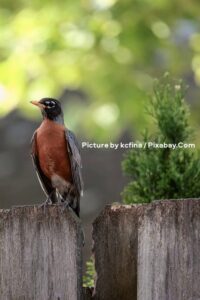
An American Robin (Turdus migratorius) perches alertly atop a weathered wooden fence post, its body angled slightly to the left as it gazes upward with a bright, watchful eye. The bird displays the species’ classic plumage: a vibrant orange-red breast and throat, contrasting sharply with its dark grayish-black head, back, and wings that show subtle white edging on the feathers. Its yellow-orange beak is slightly parted, and its legs grip the rough, splintered edge of the aged gray fence. In the softly blurred background, lush green foliage creates a bokeh effect of light and color, with a small evergreen shrub visible to the right, adding depth to the natural outdoor setting. Picture by kcfina / Pixabay.Com.
Passeriformes are divided into two main suborders: the suboscines (primarily New World birds with simpler vocal structures) and the oscines, or true songbirds, which dominate the order and exhibit the most advanced vocal learning. This vast order is organized into more than 140 families, each showcasing unique combinations of morphology, diet, and geographic range. These families highlight the order’s ecological versatility, with diets spanning insectivory, granivory, frugivory, nectarivory, and omnivory, and distributions covering virtually every continent except Antarctica. It is important to note that common names for groups of birds can sometimes appear across multiple passerine families due to similar traits resulting from comparable ecological pressures—or through historical naming conventions that predate modern classifications. For example, grosbeaks, characterized by their large, stout bills suited for cracking seeds and fruits, are found in both the Fringillidae family (such as the Pine Grosbeak (Pinicola enucleator)) and the Cardinalidae family (such as the Rose-breasted Grosbeak (Pheucticus ludovicianus)), illustrating how superficial similarities do not always align with current family classifications.
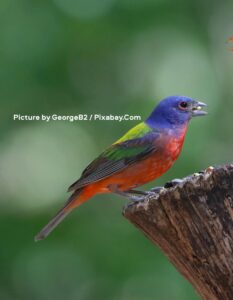
A vibrant Painted Bunting (Passerina ciris) perches alertly on the edge of a weathered wooden post, its body angled slightly to the right as it holds a small, pale seed or insect in its stout, conical beak. The bird displays an extraordinary palette of colors: a deep, saturated blue head with a subtle red eye-ring, transitioning to a bright lime-green back and wings that blend into darker tones, while its underparts glow with a rich, fiery red-orange that extends down to the tail feathers, which fade into a softer brownish hue. Its legs and feet grip the rough texture of the wood firmly, and the background consists of a soft, out-of-focus green foliage that creates a natural, serene setting. Picture by GeorgeB2 / Pixabay.Com.
Prominent families illustrate this diversity. The Corvidae family (crows, ravens, jays, and magpies) includes some of the largest and most intelligent passerines, with omnivorous diets that incorporate insects, seeds, fruits, carrion, and even small vertebrates; they occupy a nearly worldwide range, though diversity peaks in the Northern Hemisphere and Australasia, thriving in forests, farmlands, and cities alike. The Fringillidae family (finches and allies) features birds with strong, conical bills specialized for cracking seeds, making them primarily granivorous, though many supplement with insects during breeding; they are distributed across most continents (except Antarctica and Australia, where they are introduced), with high diversity in temperate and subtropical regions. The Paridae family (chickadees and tits) consists of small, acrobatic insectivores that also consume seeds and berries, especially in winter; they are concentrated in the Holarctic region (North America, Europe, and northern Asia) but extend into parts of Africa and Asia, favoring woodlands and suburban habitats. The Cardinalidae family (cardinals, grosbeaks, and buntings) displays vivid sexual dimorphism and strong conical bills adapted for a mixed diet of seeds, fruits, and insects; their range is primarily the Americas, from temperate North America to tropical South America. The Turdidae family (thrushes) is known for ground-foraging habits and a diet heavy in insects, earthworms, and fruits; they have a nearly cosmopolitan distribution, with strong representation in temperate forests worldwide and some tropical species. The Hirundinidae family (swallows and martins) specializes in aerial insectivory with long, pointed wings and wide mouths for catching flying prey; they are found globally except the coldest polar regions, often migrating long distances between breeding grounds in temperate zones and wintering areas in the tropics. Other notable families include the Muscicapidae (Old World flycatchers, insectivorous and widespread across Europe, Asia, and Africa) and the Passeridae (sparrows, primarily seed- and insect-eating and now nearly global due to human introductions).
Dietary strategies within Passeriformes are remarkably varied and often tied to bill morphology and habitat. Many families are predominantly insectivorous, especially during the breeding season when protein-rich prey supports rapid chick growth; examples include warblers (Parulidae) and flycatchers that glean, hawk, or sally after insects. Granivorous families like Fringillidae and Emberizidae exploit seeds with crushing bills, thriving in open grasslands and agricultural areas. Frugivorous and nectarivorous species, such as certain tanagers (Thraupidae) in the Neotropics or sunbirds (Nectariniidae) in Africa and Asia, play key roles in pollination and seed dispersal. Omnivorous groups like Corvidae demonstrate opportunistic feeding, allowing them to colonize human-altered landscapes. These dietary flexibilities contribute to the order’s resilience amid environmental changes.
Geographic ranges of Passeriformes reflect their adaptability: the order is absent only from Antarctica, with the greatest species richness in tropical regions of South America, Africa, and Southeast Asia, where stable climates support year-round insect and fruit availability. Temperate zones host fewer but highly migratory species that breed in summer and move south in winter to avoid food scarcity. Island endemics, such as those in Hawaii or the Galápagos, often trace their origins to mainland ancestors and show specialized diets tied to limited resources. Human activity has further expanded ranges through introductions, with species like the House Sparrow (Passer domesticus) (from Passeridae) now established on every inhabited continent.

A vibrant American Goldfinch (Spinus tristis) perches alertly on a dark curved metal rail, its body glowing with intense lemon-yellow plumage that covers the breast, belly, and back while a sharp black cap crowns its head and extends down to frame its bright eye. The bird’s wings display a striking contrast of deep black feathers accented by bold white patches along the edges, and its short conical beak shines in a vivid orange hue as it points slightly upward. Its pinkish legs grip the perch firmly with sharp claws, and the tail feathers show a mix of black and white at the tips. The entire scene is set against a softly blurred backdrop of lush green foliage that emphasizes the finch’s crisp details and brilliant coloration. Picture by milesmoody / Pixabay.Com.
Shared life habits further bind the order. Most passerines are diurnal and highly active foragers, using their perching feet to navigate vegetation with agility. Nest-building is a hallmark behavior: species construct diverse structures including open cups, enclosed domes, or cavities, often with elaborate materials like twigs, mud, or spider silk; biparental care is common, though mating systems range from monogamy to cooperative breeding in some families. Many exhibit seasonal migration, with temperate breeders traveling thousands of kilometers to exploit seasonal abundances, guided by innate cues and learned routes. Vocal communication is advanced, especially in oscines, which learn songs through imitation. Social behaviors vary from solitary territoriality to large winter flocks, and several families display notable intelligence, including problem-solving and food-caching supported by enhanced hippocampal development.
The combination of these shared physical characteristics, flexible diets, broad geographic ranges, and adaptable life habits has propelled Passeriformes to global dominance. As vital components of ecosystems—serving as insect controllers, seed dispersers, and pollinators—they remain key indicators of environmental health. From the bustling diversity of tropical families to the hardy migrants of northern latitudes, the order continues to captivate scientists and nature enthusiasts alike, offering endless insights into the diversity and resilience of the avian world.