
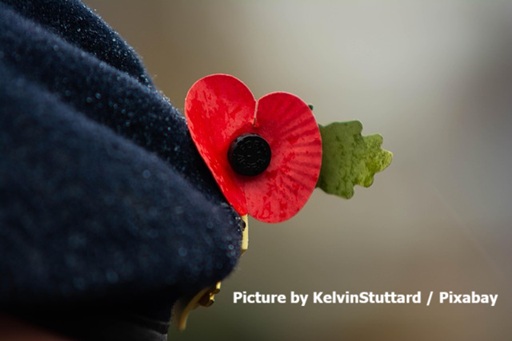
The image is a close-up photograph of a bright red poppy flower pinned to a dark navy blue wool beret. Key details: The poppy is made of fabric or paper with slightly crinkled petals, a black center (representing the seed pod), and a small green leaf attached The black center has a tiny pin or fastener visible, securing it through the beret. The beret fabric is textured wool, typical of military or ceremonial uniforms. The background is softly blurred with muted grey-brown tones, keeping the focus entirely on the poppy. A subtle gold pin or insignia is partially visible at the bottom left where the poppy is attached. This is a classic Remembrance Day poppy, traditionally worn in Commonwealth countries (including Canada) around November 11 to honour military personnel who died in war. The timing (November 11, 2025) and the Canadian user location align perfectly with Remembrance Day observances. Photographer credit in the corner: “Picture by KelvinStuttard / Pixabay”
Every year at the 11th hour of the 11th day of the 11th month, millions of Canadians and people across the Commonwealth pause for two minutes of silence. Poppies appear on lapels, wreaths are laid, and the haunting notes of the Last Post drift through cities and small towns. Remembrance Day is more than a holiday—it is a living link between generations and the sacrifices made in war and peacekeeping. Its story stretches over a century of loss, gratitude, and quiet evolution.
The birth of Armistice Day (1918–1919)
On November 11, 1918, at 11:00 a.m., the guns on the Western Front finally stopped. The Armistice with Germany ended the First World War—“the war to end all wars.” Celebrations broke out across Allied nations, but King George V soon called for a formal moment of reflection. On November 11, 1919, he asked citizens to observe two minutes of silence so that “in perfect stillness the thoughts of everyone may be concentrated on reverent remembrance.”
Canada moved quickly. Prime Minister Robert Borden proclaimed November 11 as Armistice Day, a legal holiday. In Ottawa, the first national ceremony took place at a temporary cenotaph near the old railway station. Services sprang up nationwide, many featuring the red poppy inspired by Lieutenant-Colonel John McCrae’s 1915 poem In Flanders Fields.
The interwar years and the Tomb of the Unknown Soldier (1920–1938)
In 1920, Britain and France buried unknown soldiers in Westminster Abbey and under the Arc de Triomphe. Canada waited a decade. On May 21, 1939—just months before the Second World War—the remains of an unidentified soldier from Vimy Ridge were reinterred at the new National War Memorial in Ottawa. Over 100,000 people attended, cementing the two-minute silence as a core tradition.
From Armistice to Remembrance (1939–1950s)
The Second World War proved that 1918 had not ended all wars. By 1945, Armistice Day felt too specific. In 1950, Canada officially renamed November 11 Remembrance Day to honour those who served in both world wars and the Korean War. Parliament updated the Remembrance Day Act in 1955:
“Throughout Canada on Remembrance Day, at the eleventh hour of the eleventh day of the eleventh month, there shall be observed two minutes of silence.”
The poppy campaign and the Royal Canadian Legion (1921–present)
The red poppy became Canada’s emblem in 1921 when the Great War Veterans’ Association (forerunner of the Royal Canadian Legion) adopted it after Frenchwoman Anna Guérin’s campaign. The first nationwide Poppy Campaign raised $25,000 for veterans and families. In 2024, the Legion distributed 21.6 million poppies and raised $21.3 million for veterans’ services.
Post-Cold War expansion: peacekeeping and modern conflicts
As Canada’s military role shifted to UN and NATO peacekeeping, Remembrance Day grew again. Ceremonies now explicitly honour peacekeepers lost in Cyprus, Rwanda, the Balkans, and Afghanistan. The Highway of Heroes along Ontario’s Highway 401 emerged in 2002 when crowds lined overpasses to salute fallen soldiers returning from Afghanistan; it was officially renamed in 2007.
National War Memorial and reconciliation (2000–2025)
The National War Memorial in Ottawa, originally unveiled by King George VI on May 21, 1939, has been expanded twice in the 21st century.
- 2000: The Tomb of the Unknown Soldier
On May 28, 2000—exactly 83 years after the Battle of Vimy Ridge—a Canadian Forces team exhumed the remains of an unidentified Canadian soldier from Plot 8, Row E, Grave 7 of Cabaret-Rouge British Cemetery near Souchez, France. The soldier, buried in 1917 with the inscription “A Soldier of the Great War – Known Unto God,” was chosen after exhaustive forensic checks confirmed he could not be identified. The remains were flown to Canada aboard HMCS Athabaskan, lay in state in Parliament’s Hall of Honour for three days, and were escorted along the newly named Highway of Heroes. Prime Minister Jean Chrétien, Governor General Adrienne Clarkson, and more than 20,000 Canadians attended the interment in a Quebec-granite sarcophagus. The bronze lid, cast from First World War shell casings, bears the inscription:
“To the valour of those Canadians whose sacrifice is known only unto God.”
The Tomb represents all 118,000 Canadians who died in service with no known grave.
- 2014: Plaques for Newfoundland and Afghanistan
On November 8, 2014, Prime Minister Stephen Harper and Governor General David Johnston unveiled two bronze plaques: - The Newfoundland plaque recognizes the 3,681 Newfoundlanders and Labradorians who served and the 1,747 who died in the First and Second World Wars while Newfoundland was a separate Dominion (1907–1949). It includes the line “They shall not grow old, as we that are left grow old…” in English and French.
- The Afghanistan plaque lists the 162 Canadians killed during Operation Athena (2001–2014): 158 CAF members, diplomat Glyn Berry, journalist Michelle Lang, and civilian contractors Scott Daley and Mark Graham. The inscription reads: “In the service of peace, they gave their lives in Afghanistan 2001–2014.”
In 2022, the National Aboriginal Veterans Monument on Victoria Island was rededicated with new panels in 11 Indigenous languages and LED lighting.
Legal status and regional variations
Remembrance Day is a federal statutory holiday under the Holidays Act for federally regulated employees. Provincial status (confirmed 2025):
- Full statutory holiday: Nova Scotia, Prince Edward Island, Newfoundland and Labrador, Northwest Territories, Nunavut, Yukon (added 2024).
- School/remembrance holiday: Manitoba, British Columbia.
- No statutory holiday: Ontario, Quebec, Alberta, Saskatchewan (schools still close and most businesses observe silence).
Contemporary observances and controversies
- White poppies remain a small but visible minority symbol.
- The Legion’s 2025 digital campaign #InTheirFootsteps reached 47 million impressions.
- This year—exactly 80 years after VE-Day and VJ-Day—Veterans Affairs Canada recorded 1.27 million participants at 2,900 Legion-organized ceremonies.
Conclusion: a day that refuses to fade
Remembrance Day began as a pause to mark the end of one terrible war. It has become Canada’s most solemn national ritual—honouring everyone who served, from Vimy to Kandahar, from Dieppe to Latvia. As the last First World War veteran, John Babcock, passed away in 2010 at age 109, the responsibility shifted to new generations. The poppy, the silence, and the words Lest We Forget remain our promise: as long as we remember, their sacrifice will never be in vain.
At 11:00 a.m. today—wherever you are in Canada—stop. Listen. Remember.
Lest We Forget.
À la mémoire de ceux qui ont servi.
Niinnakwana. (Cree: “We remember them.”)