
Lionel Brockman Richie Jr., born June 20, 1949, rose from Motown’s Commodores in the 1970s to become one of the defining balladeers and pop hitmakers of the 1980s. While his earlier work with the group established him as a skilled songwriter of romantic and easy-listening tracks, the decade of the 1980s marked his explosive solo breakthrough, global dominance, and string of chart-topping successes that cemented his status as one of the era’s most commercially successful artists.
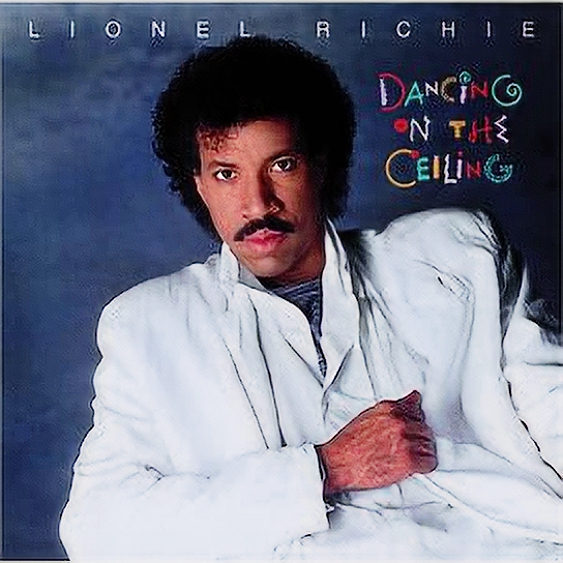
Lionel Richie’s “Dancing on the Ceiling” cover, shown above, features him chest-up on a blue background in a white jacket, with “LIONEL RICHIE” in white at the top and the colorful title lettering to his right.
The transition began even before his official solo launch. In 1980, Richie wrote and produced the Billboard Hot 100 number-one single “Lady” for Kenny Rogers. The following year, he co-wrote and produced “Endless Love,” recorded as a duet with Diana Ross. The track topped charts in multiple countries, became one of Motown’s biggest hits, and ranks among the top 20 bestselling singles of all time—serving as a career peak for both artists and a clear signal of Richie’s emerging solo potential.
In 1982, Richie formally launched his solo career with the self-titled album Lionel Richie. The record sold more than four million copies and yielded major hits, including the U.S. number-one ballad “Truly,” along with the top-five singles “You Are” and “My Love.” These songs continued the smooth, romantic style he had refined with the Commodores while introducing him as a standalone superstar.
His momentum accelerated dramatically with the 1983 follow-up, Can’t Slow Down. The album reached number one on the Billboard 200, sold over 20 million copies worldwide, and ranks among the best-selling albums of all time. It produced two massive number-one singles: the Caribbean-inflected dance anthem “All Night Long (All Night)” and the sentimental ballad “Hello.” Additional Top 10 hits from the album and its era included “Stuck on You” (No. 3), “Running with the Night” (No. 7), and “Penny Lover” (No. 8). Richie also wrote and produced “Missing You” for Diana Ross, which reached the Top 10. The album earned him two Grammy Awards, including Album of the Year, and propelled him into the top tier of international stardom. In 1984, he performed “All Night Long” at the closing ceremony of the Los Angeles Olympic Games, further amplifying his global visibility.
Richie’s influence peaked again in 1985. That year, he co-wrote the landmark charity single “We Are the World” with Michael Jackson. Inspired by the British Band Aid single “Do They Know It’s Christmas?” and initiated by activist Harry Belafonte (who approached Richie’s manager Ken Kragen), the project brought together dozens of major artists under the banner of USA for Africa (United Support of Artists for Africa) to raise funds for famine relief in Ethiopia and broader African humanitarian aid, as well as hunger relief in the United States.
Produced by Quincy Jones, the song was written by Richie and Jackson and recorded primarily on the night of January 28, 1985—immediately after the American Music Awards (which Richie hosted)—at A&M Studios in Hollywood. A sign instructed participants to “check your ego at the door.” The all-star ensemble of roughly 45–50 performers included Bruce Springsteen, Bob Dylan, Stevie Wonder, Tina Turner, Diana Ross, Billy Joel, Ray Charles, Cyndi Lauper, and many others. Richie opened the vocal performances on the track.
Released on March 7, 1985, by Columbia Records, “We Are the World” became an immediate phenomenon. It sold out its initial shipment of 800,000 copies within three days, topped the Billboard Hot 100 for four consecutive weeks beginning April 13, 1985 (the fastest rise to No. 1 in nine years at the time), and also dominated other charts including Hot R&B/Hip-Hop Songs and Adult Contemporary. With worldwide sales exceeding 20 million physical copies, it ranks among the best-selling singles of all time and was the first single certified multi-platinum in the U.S. (eventually quadruple platinum). The project ultimately raised more than $60–80 million (with some estimates exceeding $100 million over time) for famine and humanitarian relief.
At the 1986 Grammy Awards, the single won four honors: Record of the Year, Song of the Year (accepted by Richie and Jackson), Best Pop Performance by a Duo or Group with Vocal, and Best Music Video, Short Form. It also earned an American Music Award and a People’s Choice Award, solidifying its status as a cultural and philanthropic milestone of the decade.
That same year, Richie wrote and performed “Say You, Say Me” for the film White Nights. The song topped the U.S. charts for four weeks, became one of the biggest hits of 1986, and earned both an Academy Award and a Golden Globe for Best Original Song.
In 1986, Richie released Dancing on the Ceiling, his third solo album and the last major commercial peak of the decade. It delivered a run of hits including the number-one “Say You, Say Me,” the title track (which peaked at No. 2), “Love Will Conquer All” (No. 9), “Ballerina Girl” (No. 7), and “Se La” (No. 20). The album confirmed his mastery of both upbeat pop and lush ballads.
By the mid-to-late 1980s, Richie had established himself as one of the decade’s most successful balladeers. His string of number-one hits, multi-platinum albums, high-profile collaborations—including the transformative “We Are the World”—and awards made him a dominant force on radio, charts, and stages worldwide. After Dancing on the Ceiling, he stepped back from recording for an extended period beginning around 1986, though the foundation laid in the 1980s—marked by massive sales, awards, and cultural impact—remains the core of his legacy as a solo artist. Over his career he has sold more than 90 million records, with the 1980s output forming the commercial and artistic high point.