
The Budgerigar (Melopsittacus undulatus), commonly known as the Budgie, is a small, lively parrot native to Australia. It is classified in the order Psittaciformes and the family Psittaculidae. It is also known by other names such as the Common Parakeet, Shell Parakeet, Warbling Grass Parakeet, Canary Parrot, Zebra Parrot, or Scallop Parrot. Celebrated for its vibrant appearance, cheerful personality, and remarkable ability to mimic sounds, the Budgerigar has become one of the world’s most popular pet birds, ranking among the top companions after dogs and cats thanks to its compact size, relatively low cost of care, and engaging nature that allows it to form strong bonds with people. In the wild, these birds thrive in Australia’s vast interior landscapes, while in homes around the globe, they bring joy through their constant chatter and playful antics.
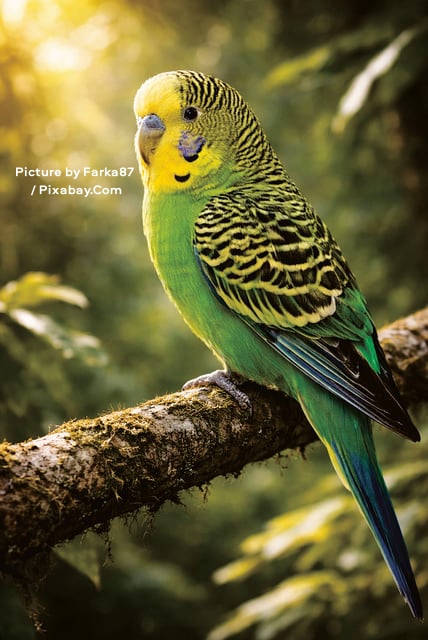
the image above shows a vibrant green Budgerigar perched gracefully on a moss-covered branch, its yellow head marked with fine black scalloped patterns, a blue cere above its beak, and wings featuring intricate yellow and black barring that fade into solid green plumage with a long blue-tipped tail, set against a soft, sunlit forest background of blurred green foliage and warm golden light filtering through the trees. Image by Farka87 / Pixabay.Com.
| Class | Aves |
| Order | Psittaciformes |
| Family | Psittaculidae |
| Genus | Melopsittacus |
| Species | M. undulatus |
| Binomial Name | Melopsittacus undulatus |
| Length | 17-20 cm (7-8 inches) |
| Weight | 22-40 grams (0.78-1.7 oz) |
| Wingspan | About 30 cm (1 foot) |
| IUCN Status | Least Concern |
Physical description
Wild Budgerigars measure about 17 to 20 centimeters (7 to 8 inches) in length from the tip of the beak to the end of the tail and typically weigh between 22 and 40 grams. They have a streamlined body, pointed wings, and a long, slender tail.
Their natural plumage features a bright yellow face and forehead, with black barring or scalloping across the head, nape, back, and wings. The underparts are green, the cheeks show a distinctive blue or violet patch, and there are black spots on the throat. The tail is dark blue or bluish, and the eyes of adult birds are white or pale yellow. Juveniles appear duller overall, with barred foreheads and darker brown eyes.
Adult males and females can be distinguished by the colour of the cere—the fleshy area surrounding the nostrils above the beak. In males, the cere is typically bright blue, while in females it is brownish or tan, especially during breeding periods (otherwise lighter blue).
In captivity, selective breeding has produced an astonishing variety of colours and patterns, including pure white, blue, yellow, mauve, olive, grey, and combinations with crests or other modifications.
Habitat and distribution
Budgerigars inhabit the arid and semi-arid interior of mainland Australia. They are found across much of the continent west of the Great Dividing Range, in open habitats such as grasslands, savannas, scrublands, open woodlands, and farmlands. Preferred environments often include areas with spinifex grass, dry mallee, mulga scrub, and riverine woodlands, where they can readily access seeds and occasional water. They are generally absent from Tasmania, the far south-west, Cape York Peninsula, and most coastal regions of the east, north, and south-west.
These birds are highly nomadic. Flocks move in response to rainfall and the availability of food and water, sometimes forming groups of hundreds or even tens of thousands after periods of abundant rain. They may undertake seasonal movements, such as shifting northward during cooler months, and are rarely found far from a reliable water source. When standing water is scarce, they will drink morning dew or bathe in wet grass. Agricultural developments providing extra water have allowed them to expand into some previously less suitable areas in parts of their range.
Behaviour and social life
Budgerigars are highly social and active birds. In the wild, they live in flocks and communicate constantly with a distinctive chirruping or warbling call, interspersed with sharper notes. They are diurnal, spending their days foraging, preening, and interacting.
They are monogamous and typically form lifelong pairs. Their flight is undulating and agile, aided by their pointed wings and long tails.
Diet
Budgerigars are primarily granivorous, feeding mainly on seeds from native grasses, herbs, and other plants, such as spinifex and tussock grasses. They forage on or near the ground, using their specialised beaks to de-husk seeds before swallowing them. They may also consume seeds from crop plants when available and occasionally other plant material.
Fresh water is essential; they can drink a significant portion of their body weight daily.
Breeding
Breeding in Budgerigars is opportunistic and often follows rainfall, which ensures ample food. They nest in existing cavities in tree trunks, branches, logs, or even fence posts, lining them simply. Clutches usually consist of 4 to 8 white eggs. The female incubates them for 18 to 21 days, while the male provides food. Chicks fledge around 30 days after hatching but may remain with the parents longer.
Conservation status
The Budgerigar is classified as Least Concern by the IUCN. Populations fluctuate with environmental conditions, particularly droughts, but the species remains widespread and abundant in its native range. Introduced populations exist in places such as Florida.
Interesting notes
The scientific name Melopsittacus undulatus translates roughly to “melodious parrot with wave-like patterns,” referring to the scalloped markings on the wings.
Whether soaring in colourful flocks across the Australian outback or brightening a living room with cheerful songs, the Budgerigar continues to captivate people everywhere with its beauty, intelligence, and lively spirit.