
The FIFA World Cup stands as the world’s most prestigious and widely watched sporting event. Every four years, it unites nations, ignites passion across continents, and showcases the pinnacle of men’s international association football (also commonly known as soccer in countries such as the United States and Canada). What began as a modest 13-team invitational tournament in 1930 has evolved into a global spectacle involving 32 teams (soon expanding to 48), sophisticated technology, massive commercialization, and profound cultural impact.
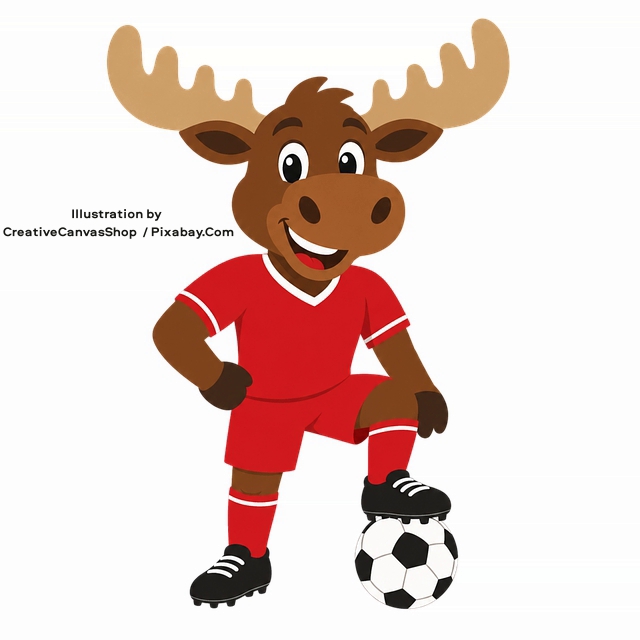
the Illustration above shows a cheerful cartoon Moose character with large brown antlers, expressive wide eyes, and a big smiling mouth revealing teeth and tongue, dressed in a full red soccer uniform including a short-sleeved jersey with white trim, matching shorts, red socks with white bands, and black cleats with white stripes. The moose stands confidently with one hand on its hip and the other leg raised, its foot resting atop a classic black-and-white soccer ball, while its body faces forward in a dynamic pose against a plain white background. Illustration by CreativeCanvasShop / Pixabay.Com.
Origins: Jules Rimet’s vision
Football’s international roots trace back to the late 19th century, with the first official match between Scotland and England in 1872 and early Olympic tournaments. However, the Olympics restricted participation to amateurs, clashing with football’s growing professionalism. FIFA, founded in Paris in 1904, sought an independent world championship.
Frenchman Jules Rimet, FIFA president from 1921 to 1954, championed the idea. On 28 May 1928, the FIFA Congress in Amsterdam approved a FIFA-organized world tournament open to professionals. Uruguay—double Olympic champions in 1924 and 1928 and celebrating its centenary of independence in 1930—volunteered to host and cover costs for participating teams.
The original trophy, designed by French sculptor Abel Lafleur, depicted Nike, the Greek goddess of victory. It was later renamed the Jules Rimet Trophy in 1946.
Uruguay 1930: The inaugural tournament
The first FIFA World Cup kicked off on 13 July 1930 in Montevideo. FIFA invited teams rather than holding qualifiers, resulting in only 13 participants: seven from South America, four from Europe (Belgium, France, Romania, and Yugoslavia), and two from North America. Many European nations declined the long transatlantic voyage, despite Rimet’s personal efforts to persuade them. The four European teams traveled together with Rimet aboard the ship Conte Verde.
The tournament featured a unique format of four groups (three of three teams and one of four), with the group winners advancing to semi-finals. The first two matches occurred simultaneously: France beat Mexico 4–1 (with Lucien Laurent scoring the World Cup’s first-ever goal) and the United States defeated Belgium 3–0. Bert Patenaude of the USA later scored the tournament’s first hat-trick. All 18 matches were played in Montevideo, most at the newly constructed Estadio Centenario, built specifically for the event. Uruguay defeated Argentina 4–2 in the final before a crowd of around 93,000, becoming the first champions. The tournament was a notable success both sportingly and financially.
Pre-war expansion and interruptions (1934–1938)
Italy hosted in 1934—the first with a qualifying competition (32 entrants for 16 spots). Hosts Italy won the final against Czechoslovakia in extra time. Uruguay boycotted in protest over European absences in 1930.
France hosted in 1938. Italy defended its title, beating Hungary 4–2. Austria withdrew due to the Anschluss. The tournament was cancelled in 1942 and 1946 due to World War II.
Post-war resumption and the golden era (1950–1970)
The tournament returned in 1950 in Brazil. With 13 teams again and no traditional final, Uruguay stunned hosts Brazil 2–1 in the decisive match (the “Maracanazo”) before an estimated 200,000 spectators.
Switzerland 1954 saw West Germany’s “Miracle of Bern,” defeating the dominant Hungary 3–2. Sweden 1958 marked Brazil’s first title, propelled by a 17-year-old Pelé. Brazil repeated in 1962 (Chile) and achieved a historic third victory in 1970 (Mexico), securing permanent ownership of the Jules Rimet Trophy.
Pelé’s era symbolized football’s growing artistry and global appeal. England won at home in 1966, while defensive and physical play marked some tournaments (e.g., the “Battle of Santiago” in 1962).
Expansion and modernization (1974–2022)
A new FIFA World Cup Trophy, designed by Italian sculptor Silvio Gazzaniga, debuted in 1974. It features two athletes lifting the globe and weighs 6.175 kg in 18-carat gold. Unlike its predecessor, it is not awarded permanently—winners receive a replica.
Format changes reflected football’s globalization:
- 16 teams dominated from 1954 to 1978.
- Expansion to 24 teams in 1982 (Spain) added a second group stage initially, then a round of 16.
- 32 teams from 1998 (France) to 2022 standardized the format: eight groups of four, followed by knockout stages (64 matches).
Iconic moments defined these eras. Diego Maradona’s “Hand of God” and “Goal of the Century” against England in 1986 propelled Argentina to victory. Zinedine Zidane’s headbutt in the 2006 final capped Italy’s triumph. Brazil claimed its fifth title in 2002.
Technological advances included goal-line technology (2014) and VAR (2018 onward). The tournament became truly global: first in Africa (South Africa 2010), Asia (co-hosted by Japan/South Korea 2002), and the Middle East (Qatar 2022, held in winter).
Challenges, controversies, and commercial growth
Hosting bids have sparked controversies, including allegations of corruption, human rights concerns (e.g., 1978 Argentina, 2010 South Africa, 2018 Russia, 2022 Qatar), and political tensions. FIFA has faced major scandals, yet the event’s popularity endures.
Commercialization has exploded since the late 20th century, turning the World Cup into one of the most lucrative sporting events on the planet. Broadcasting rights form the largest revenue stream, driven by global TV and digital audiences. For the 2022 tournament in Qatar, FIFA generated about $3.4 billion from media rights alone, with projections for the 2026 cycle (including the expanded 48-team format and 104 matches) reaching around $4 billion or more. Sponsorship and marketing rights contribute billions more, with major global partners (e.g., Adidas, Coca-Cola, and new entrants like Aramco) paying premium fees for brand association. Ticketing, hospitality packages, and licensing add further significant income.
FIFA’s four-year revenue cycles have grown dramatically: from roughly $6.4 billion in 2015–2018 to $7.5 billion for the 2019–2022 cycle, with projections approaching $13 billion for 2023–2026 (of which ~$8.9 billion is tied directly to the 2026 tournament). This growth is fueled by more matches, favorable viewing times in key markets like North America and Europe, digital streaming innovations, and expanded commercial opportunities. The event also delivers substantial broader economic impact—FIFA and partners estimate tens of billions in global GDP contributions and hundreds of thousands of jobs, particularly for host nations through tourism, infrastructure, and related spending.
The World Cup drives economic activity for hosts while fostering national pride and unity, though debates continue over the distribution of benefits versus costs.
The future: 2026 and beyond
The 2026 tournament, co-hosted by the United States, Canada, and Mexico—the first tri-nation hosting—expands to 48 teams and 104 matches. It features 16 groups of three, with the top two plus the best third-placed teams advancing to a round of 32. This aims to include more nations as football develops worldwide.
Subsequent editions (2030 multi-host centenary, 2034 Saudi Arabia) will continue this inclusive trajectory.
Enduring legacy
From Jules Rimet’s dream to a billion-viewer phenomenon, the FIFA World Cup has transformed football into a universal language. Brazil leads with five titles, followed by Germany and Italy (four each), and Argentina (three). It has launched legends, created unforgettable moments, and reflected broader social and political currents.
As it enters its next chapter with greater inclusivity and innovation, the World Cup remains a celebration of skill, passion, and the beautiful game’s power to connect humanity. Its history is one of ambition, resilience, and continuous evolution—mirroring football itself.