
Canidae (pronounced /ˈkæn.ɪ.diː/, from the Latin canis, meaning “dog”) is a family of carnivorous mammals belonging to the suborder Caniformia. Its members are called canids and are commonly referred to as dogs. The family includes three subfamilies: the Caninae, and the extinct Borophaginae and Hesperocyoninae.
The Caninae encompass all modern species, including Domestic Dogs [Canis lupus familiaris], wolves, Coyotes [Canis latrans], foxes, jackals, Raccoon Dogs [Nyctereutes procyonoides], and others.
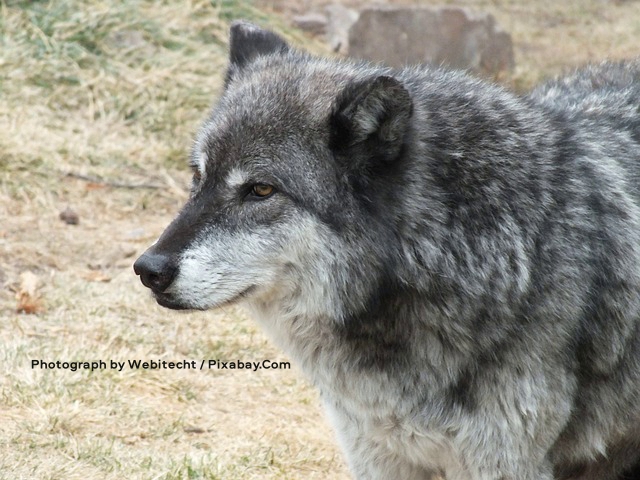
The photograph above shows a close-up profile view of a Gray Wolf (Canis lupus) standing in a natural outdoor setting with dry grass and rocks in the background. The wolf faces left with its head slightly turned, displaying a thick coat of mixed gray, black, and white fur that appears textured and layered, with prominent white markings on its muzzle, chin, and chest area, while its alert ears are perked up and its golden-yellow eye is visible with a focused gaze. Its black nose and snout complete the realistic wildlife portrait captured in natural daylight.
Photograph by Webitecht / Pixabay.Com.
Physical characteristics
Canids share a recognizable and fairly uniform body plan. They typically have long muzzles, erect ears, powerful jaws with teeth adapted for both slicing flesh and cracking bones, relatively long legs, and bushy tails. The length and quality of their fur (pelage) vary with the season. The muzzle portion of the skull is much more elongated than that of cats. The zygomatic arches are wide, there is usually a transverse lambdoidal ridge at the rear of the cranium, and in some species a sagittal crest runs from front to back. The bony orbits around the eyes never form a complete ring, and the auditory bullae are smooth and rounded.
Most species are digitigrade, walking on their toes. The tip of the nose is always naked. The feet have cushioned pads consisting of a single pad behind the tip of each toe and a more-or-less three-lobed central pad. Hairs grow between the pads; in the Arctic Fox [Vulpes lagopus] the soles of the feet are densely covered with hair during winter. With the exception of the African Wild Dog [Lycaon pictus], which has only four toes on the forefeet, canids have five toes on the front feet (though the thumb is reduced and does not reach the ground) and four toes on the hind feet. Some Domestic Dogs possess a vestigial fifth toe on the hind feet known as a dewclaw. Their claws are generally non-retractile and blunt, although some species have sharper, partially retractile claws.
Females have three to seven pairs of mammary glands. Young canids are born blind, with their eyes opening a few weeks after birth.
Males have a baculum (penis bone) and a bulbus glandis that expands during mating, creating a copulatory tie that can last up to an hour.

The photograph above shows a Red Fox (Vulpes vulpes) standing alert on a patch of rocky ground interspersed with sparse green grass and small plants, its body oriented in profile as it gazes intently toward the right side of the frame with its head slightly lowered. The fox has vibrant reddish-orange fur covering its head, back, and sides, contrasted by a lighter white and gray underbelly and throat, while its lower legs and paws appear dark blackish, and its long bushy tail features a mix of brown and darker tones. Its ears are perked upright, and its dark eyes and pointed snout convey a watchful expression against a softly blurred natural background of greenery and stones. Photograph by rupertbanano / Pixabay.Com.
Size and variation
Canids display dramatic size differences. The largest is the Gray Wolf [Canis lupus], which can reach about 2 metres (6.6 ft) in length and weigh up to 79 kg (174 lb). The smallest is the Fennec Fox [Vulpes zerda], which may measure only 24 cm (9.4 in) in length and weigh as little as 0.6 kg (1.3 lb). Body proportions also vary: most species have lithe, long-legged builds suited for running, while a few (such as the bush dog) are stockier.
Distribution and habitat
Canids are found on every continent except Antarctica. Wild populations are native across North America, South America, Europe, Asia, and Africa. They are absent as native species from Australasia and Antarctica, although feral populations of Domestic Dogs and certain other canids have been introduced by humans to Australia and New Guinea.
Canids occupy an exceptionally wide variety of habitats. These range from hot, arid deserts (such as the Sahara and Arabian deserts, home to the Fennec Fox and Pale Fox [Vulpes pallida]) to cold tundra and polar regions (inhabited by Arctic Foxes and Gray Wolves). They are common in open grasslands and savannas (where African Wild Dogs, Maned Wolves [Chrysocyon brachyurus], and Coyotes thrive), dense forests and woodlands (supporting Red Foxes [Vulpes vulpes], Gray Foxes [Urocyon cinereoargenteus], Dholes [Cuon alpinus], and various jackals), and rugged mountainous terrain. Many species are highly adaptable and successfully live in human-modified environments, including farmlands, suburbs, and even large cities. Red Foxes and Coyotes, for example, are now frequently seen in urban areas across much of North America, Europe, and Asia.
Only a few species are arboreal or semi-arboreal. The Gray Fox [Urocyon cinereoargenteus] and the closely related Island Fox [Urocyon littoralis] are skilled tree climbers, often using trees for resting, escaping predators, or foraging. The Raccoon Dog also habitually climbs trees and is known to den in hollow trunks.
Behavior and social life
Most canids are social animals that live in family groups or packs. Many species form monogamous pairs that cooperate in hunting and raising young. Larger species, such as Gray Wolves and African Wild Dogs, often live in bigger packs that can number up to 40 individuals. These packs are usually territorial and maintain a dominance hierarchy in which typically only the dominant pair breeds.
Canids communicate through scent marking (urine and secretions from various glands), vocalizations (barks, howls, growls), and visual signals. They generally sleep in the open but use underground dens for breeding and shelter during bad weather.
Reproduction
Canids exhibit several reproductive traits that are relatively uncommon among mammals. They are typically monogamous, males provide parental care, and mating involves a copulatory tie. Non-breeding adult offspring often remain in the group and help raise younger siblings (alloparenting).
Most species are spontaneous ovulators. Breeding is usually seasonal and influenced by day length. Gestation lasts 50–65 days depending on body size. Litters range from 1 to more than 16 pups, which are born small, blind, and helpless. Both parents—and often other pack members—regurgitate food for the young. Pups generally take about a year to reach maturity.
Relationship with humans
The Domestic Dog was the first animal domesticated by humans. Archaeological evidence shows dogs living alongside people as early as 14,700 years ago. The relationship likely developed because wolves were social pack animals, and humans benefited from their tracking, hunting, and protective abilities, while dogs gained access to food and safety.
Although most canids avoid humans, the Gray Wolf has occasionally preyed on people. Rare documented cases also exist of Coyotes and Golden Jackals [Canis aureus] killing humans (mainly children).
Humans have long hunted certain canids for fur, sport, or to protect livestock. Today, several species face serious threats from habitat loss, depletion of prey, persecution, and diseases transmitted by Domestic Dogs. The Dhole, for example, is now endangered in much of its range.
This family represents one of the most successful and adaptable groups of carnivores, combining distinctive physical traits with remarkable behavioral flexibility that has allowed them to thrive across diverse environments and form a close partnership with humans.