
In the glittering, excess-laden world of 1980s pop music — an era dominated by big hair, oversized shoulder pads, bombastic guitar-driven anthems, and larger-than-life stadium rock — the Pet Shop Boys stood out as a strikingly cool, minimalist, and cerebral alternative. The British duo of Neil Tennant and Chris Lowe brought something distinctly modern and intelligent to the charts: they fused icy, atmospheric synth textures with pulsating dance beats and razor-sharp, literate lyrics, creating a sleek and intellectually engaging brand of electronic pop that felt both futuristic and emotionally grounded. Emerging from London’s vibrant club scene in the early 1980s, they played a key role in the Second British Invasion of American charts, helping to shift mainstream pop toward sophisticated synth-driven sounds while demonstrating that electronic music could be witty, culturally observant, and dancefloor-ready at the same time.
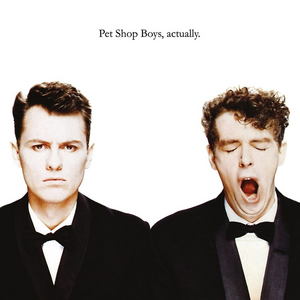
The album cover, shown above, for Pet Shop Boys’ 1987 release Actually features a minimalist, high-contrast photograph of the duo against a plain white background. Neil Tennant stands on the left, gazing directly at the viewer with a stern, slightly scowling expression, while Chris Lowe on the right is captured mid-yawn with his mouth wide open and eyes closed. Both wear formal black tuxedos with white shirts and black bow ties. At the top of the image, small elegant serif text reads “Pet Shop Boys, actually.” with “actually” in lowercase italics, creating a witty, deadpan contrast between their sophisticated attire and candid, humorous expressions. The tightly cropped design emphasizes their faces and upper bodies with no additional elements, resulting in a clean, iconic, and instantly recognizable image.
Their story began with a serendipitous meeting that captured the spirit of the early 1980s electronic underground.
A Chance Encounter Sparks a Duo
On August 19, 1981, at the Chelsea Record Centre in London, aspiring journalist Neil Tennant (then working at Smash Hits magazine) was buying a Korg MS-10 synthesizer. Architecture student Chris Lowe assisted him with a connector. Their shared passion for disco, New York club music, and emerging synth acts like Soft Cell, Orchestral Manoeuvres in the Dark (OMD), Kraftwerk, the Human League, and Depeche Mode ignited an instant creative partnership.
They began writing and recording in Tennant’s Chelsea flat and later a small Camden Town studio. Early influences included Hi-NRG disco producers like Bobby Orlando and the atmospheric electronic sounds filtering from gay clubs. The name “Pet Shop Boys” came from friends who worked in a pet shop in Ealing (with a playful nod to the Beastie Boys).
By 1983, Tennant’s music journalism connections led to a pivotal New York meeting with producer Bobby Orlando. Demos for tracks like “It’s a Sin” and “Opportunities (Let’s Make Lots of Money)” resulted in a batch of recordings that blended electro, Hi-NRG, and narrative-driven pop.
Early Releases and the Road to Breakthrough
Their first single, an Orlando-produced version of “West End Girls,” arrived in April 1984. It became a minor club hit in Los Angeles, San Francisco, Belgium, and France but barely registered in the UK. Follow-ups like “One More Chance” also struggled. The duo parted ways with Orlando in 1985 and signed with Parlophone (EMI), managed by Tom Watkins.
The turning point arrived with a complete re-recording of “West End Girls,” produced by Stephen Hague. The original Orlando version had enjoyed only modest success as a dancefloor import in parts of the US and Europe, but it failed to make any real impact on the UK charts. Hague’s more sophisticated production completely reinvented the track, replacing its rawer edges with lush, atmospheric synth layers, a powerful driving bassline, crisp drum programming, and a cinematic sense of space that allowed Tennant’s cool, half-spoken vocals to shine. The new arrangement gave the song a moody, film-like quality while sharpening its incisive lyrics about London nightlife, social contrasts, and urban ambition. Released in late 1985, the re-recorded “West End Girls” exploded onto the charts, reaching number one on the UK Singles Chart in January 1986 and simultaneously topping the US Billboard Hot 100 — a rare double triumph for a British synth-pop act during the Second British Invasion. The single went on to sell more than 1.5 million copies worldwide and instantly became one of the defining tracks of the decade, establishing the Pet Shop Boys’ signature sound of intelligent, danceable electronic pop.
The Breakthrough Albums: Please, Actually, and Introspective
The success propelled their debut album Please (released March 24, 1986). It reached number three in the UK and number seven in the US (their only platinum-certified album there). Standout tracks included the reissued “Opportunities (Let’s Make Lots of Money)” (a satirical take on Thatcher-era ambition), “Love Comes Quickly,” and “Suburbia.”
Their 1987 follow-up Actually (September 1987) marked their commercial and artistic peak in the decade. The lead single “It’s a Sin” became their second UK number one in June 1987. Produced with sweeping, cinematic synth orchestration and dramatic builds, the track featured Tennant’s confessional delivery over lush electronic arrangements. Its lyrics drew from Tennant’s Catholic school upbringing, exploring themes of guilt, repression, and the weight of religious doctrine in a bold, theatrical style that stood out even in the melodramatic pop landscape of the era. The song sparked notable controversy in Britain: Tennant’s former school publicly criticised it, and conservative commentator Jonathan King launched a plagiarism lawsuit against the duo (which he ultimately lost). Released during the height of the AIDS crisis and amid growing social and political tensions in the UK, “It’s a Sin” resonated powerfully as a statement on personal freedom and the lingering effects of guilt and shame. The duo later performed the track at benefits opposing the controversial Section 28 legislation, further cementing its cultural significance. Other major hits from the album included the Dusty Springfield duet “What Have I Done to Deserve This?” (UK and US number two), which brilliantly revived the legendary singer’s career, “Rent,” and the Elvis Presley cover “Always on My Mind,” which became the UK Christmas number one in 1987.
Introspective (October 1988) shifted toward longer, more dancefloor-oriented tracks (essentially six extended pieces). Produced in part by Trevor Horn on “Left to My Own Devices,” it showcased their growing confidence with house and orchestral-tinged electronics. “Heart” (UK number one, March 1988) and later singles like “Domino Dancing” kept them dominant on the charts.
By the end of the decade, the Pet Shop Boys had scored four UK number-one singles in the 1980s (“West End Girls,” “It’s a Sin,” “Always on My Mind,” and “Heart”) and five US top-10 hits, cementing their status alongside acts like Duran Duran and Culture Club in the Second British Invasion.
Musical Innovations and Signature Style
The Pet Shop Boys didn’t just ride the synth-pop wave—they refined it. Their sound featured lush, layered synthesizers, precise sequencers, and a polished production that balanced club energy with pop accessibility. Tennant’s cool, deadpan vocal delivery contrasted with Lowe’s minimalist keyboard work and static stage presence (Lowe often stood motionless behind his synths while Tennant performed).
Lyrically, they brought sophistication and irony to dance music. Songs tackled consumerism, urban alienation, relationships, and personal themes with wit and emotional depth rather than overt sloganeering. This “brainy” approach—drawing from club culture yet appealing to mainstream audiences—distinguished them from flashier 1980s contemporaries.
They collaborated with top producers (Hague, Horn) and seamlessly incorporated covers, remixes, and extended mixes, influencing how dance music was packaged and consumed.
Beyond charts, the Pet Shop Boys contributed to the mainstreaming of electronic dance music rooted in gay club scenes. They helped prove that synth-driven pop could be both commercially massive and artistically credible, paving the way for future electronic acts while bridging underground sounds with radio-friendly hits. Awards like the 1987 BRIT for “West End Girls” and Ivor Novello recognition affirmed their songwriting prowess.
By decade’s end, with albums like Please, Actually, and Introspective forming a formidable trilogy, the Pet Shop Boys had not only conquered the 1980s pop landscape but helped shape its sonic and thematic DNA. Their cool detachment, dancefloor sophistication, and sharp observations made them enduring icons of an era defined by electronic innovation. Decades later, their 1980s work remains a benchmark for intelligent, emotionally complex pop music.