Ireland is a captivating island nation in the North Atlantic, celebrated worldwide as the “Emerald Isle” for its vibrant green pastures, misty mountains, and dramatic Atlantic coastline. Geographically, it forms a single landmass divided politically between the Republic of Ireland (occupying roughly five-sixths of the island) and Northern Ireland (part of the United Kingdom, in the northeast). Its position on the western edge of Europe, combined with a mild oceanic climate and complex geological history, has created a remarkably varied yet compact landscape where no point lies more than about 110 km (68 mi) from the sea.
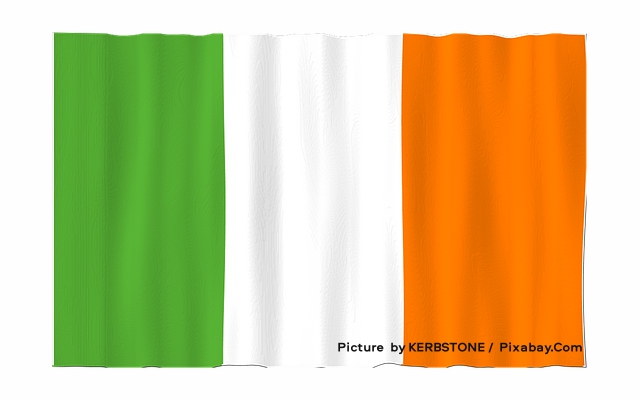
the image above displays the national flag of Ireland, commonly known as the Irish tricolour, featuring three equal vertical stripes of vibrant green on the left, white in the center, and orange on the right, all rendered with a realistic fabric texture and gentle undulating waves as if fluttering in a breeze against a clean white background. Picture by KERBSTONE / Pixabay.Com.
Location, size, and overall shape
Ireland lies between approximately 51°30′ and 55°30′ N latitude and 6° and 10°30′ W longitude. It is the third-largest island in Europe and the 20th-largest in the world, with a total area of 84,421 km² (32,595 sq mi). The island stretches roughly 480 km (298 mi) north to south and 275 km (171 mi) east to west. It is separated from Great Britain by the Irish Sea and North Channel, and from mainland Europe by the Celtic Sea and St George’s Channel.
The terrain follows a classic “saucer” or “basin-and-rim” pattern: a broad, low-lying central plain (the Midlands) is almost completely encircled by coastal mountain ranges and hills. This central lowland, largely underlain by limestone, sits mostly between 60 m (197 ft) and 120 m (394 ft) above sea level and is dotted with bogs, lakes, and low ridges.
Mountains and uplands
Although Ireland’s mountains are not exceptionally high by European standards, they create some of the island’s most striking and varied scenery, especially along the western, southern, and northern fringes. The mountains form a broken ring around the central lowlands, with the highest and most rugged terrain concentrated in the southwest and west. Only three peaks exceed 1,000 metres, yet the uplands cover a significant portion of the island and strongly influence local climate, drainage, and settlement patterns.
The highest peak is Carrauntoohil (1,039 m (3,409 ft)), located in the MacGillycuddy’s Reeks of County Kerry. This dramatic sandstone range is renowned for its sharp ridges, deep glacial corries, and steep slopes carved by Ice Age glaciers. It offers some of Ireland’s most challenging and rewarding hiking, with panoramic views across the Iveragh Peninsula and the Atlantic. Nearby ranges such as the Slieve Mish Mountains and the Caha Mountains add to the wild, fjord-like character of the southwest.
Further east, the Wicklow Mountains form the largest continuous upland area in the Republic of Ireland. Composed mainly of granite, they rise to 926 m (3,038 ft) at Lugnaquilla and are crossed by the popular Wicklow Way, one of Ireland’s longest waymarked walking trails. The range features rounded summits, deep glacial valleys, and picturesque lakes, providing a scenic backdrop to Dublin while remaining surprisingly remote in places.
In Northern Ireland, the Mourne Mountains rise dramatically from the sea in County Down, culminating at Slieve Donard (850 m (2,789 ft)), the highest point in Northern Ireland. These granite peaks are famous for the Mourne Wall, a 36 km (22 mi) dry-stone wall built in the early 20th century that links many of the summits and remains a popular hiking challenge. The Sperrin Mountains in the northwest offer gentler, more rounded terrain, with Sawel Mountain (678 m (2,224 ft)) as their highest point.
The west of Ireland features the distinctive Twelve Bens (or Twelve Pins) and the Maumturk Mountains in Connemara, County Galway. These quartzite peaks create a jagged, almost lunar landscape of rocky summits and steep slopes, popular with experienced hillwalkers. Further north, the Derryveagh Mountains and Nephinbeg range in Donegal include some of the most remote and wild upland areas on the island.
Inland, the Galtee Mountains in County Tipperary stand out as the highest range entirely away from the coast, while the Slieve Bloom Mountains form a natural boundary between the midlands and the southeast. The Antrim Plateau in Northern Ireland, with its basalt cliffs and the famous Glens of Antrim, adds another distinctive upland character to the northeast.
Many of these ranges were heavily shaped by the last Ice Age, resulting in U-shaped valleys, corries, and moraines. Today they support important habitats for upland birds and rare plants, and they play a key role in Ireland’s tourism and outdoor recreation economy through hiking, climbing, and scenic drives.
Rivers, lakes, and inland waters
Ireland’s hydrology is rich, with water bodies covering about 2% of the land. The island’s longest river is the River Shannon (360.5 km (224 mi)), which rises in County Cavan and flows south through Lough Allen, Lough Ree, and Lough Derg before widening into the Shannon Estuary. It effectively divides the western third of the island from the rest and has long been vital for transport, fishing, and power generation.
The largest lake is Lough Neagh (392 km² (151 sq mi)), located in Northern Ireland and shared by several counties; it is the largest lake in the British Isles. Other significant lakes include Lough Corrib (the largest entirely in the Republic, 176 km² (68 sq mi)), Lough Mask, Lough Conn, and the two parts of Lough Erne in Fermanagh.
The central limestone lowlands and glacial history have produced thousands of smaller lakes (loughs) and an extensive network of rivers and streams. Peat bogs — both raised and blanket bogs — are a defining feature of the midlands and western uplands, storing carbon and supporting unique ecosystems.
Coastline, peninsulas, and islands
Ireland’s coastline is one of its most spectacular assets — highly indented in the west and smoother in the east. The total length is approximately 7,524 km (4,675 mi), featuring countless bays, inlets, headlands, and sea cliffs.
The west coast is particularly rugged, with famous peninsulas such as Dingle, Iveragh (home to the Ring of Kerry), and Beara. Iconic sites include the Cliffs of Moher in County Clare, rising dramatically over 200 m (656 ft) above the Atlantic. Major inlets include Galway Bay, the Shannon Estuary, Clew Bay, and Donegal Bay.
Notable islands include Achill Island (the largest offshore island, connected by bridge), the Aran Islands (famous for their Irish-speaking culture and karst landscapes), Valentia Island, and the remote Blasket Islands. The northernmost point is Malin Head in County Donegal.
The east coast, by contrast, has fewer deep indentations but important harbours such as Dublin Bay, Wexford Harbour, and Belfast Lough.
Climate: mild, moist, and changeable
Ireland enjoys a temperate oceanic climate (Cfb in the Köppen system), strongly moderated by the North Atlantic Current (an extension of the Gulf Stream). This keeps winters remarkably mild for the latitude — average January temperatures around 5–7°C — and prevents extremes of heat or cold.
Rainfall is abundant and varies significantly from west to east. Western areas (e.g., Valentia Island) can receive over 1,500 mm annually, while eastern areas around Dublin average 700–800 mm. The climate is famously changeable, with Atlantic depressions bringing frequent showers and strong winds, especially in winter. Summers are mild, with long daylight hours.
This consistently moist, mild environment is the primary reason for Ireland’s lush green appearance, supporting productive grasslands even on relatively thin soils.
Geological foundations
Limestone dominates the central plain (remnants of ancient tropical seas), while granite, sandstone, and basalt form the mountain fringes. The Burren region in County Clare is a world-famous karst landscape of exposed limestone pavements.
A landscape shaped by nature and time
Ireland’s geography is intimate yet dramatic — a compact island where mountains, bogs, rivers, and a wild Atlantic coastline coexist within easy reach. The central lowlands provide fertile farmland, while the western and northern fringes offer some of Europe’s most spectacular coastal and mountain scenery.
Whether standing atop Carrauntoohil, gazing across the Cliffs of Moher, boating on the Shannon, or walking the quiet midland bogs, visitors and residents alike experience a landscape that is both gentle and powerfully evocative. The Emerald Isle’s geography continues to shape its culture, economy, and identity in profound ways.
This natural diversity — mild climate, varied terrain, and proximity to the sea — remains Ireland’s greatest geographical asset.