
Thomas Alva Edison, born on February 11, 1847, in Milan, Ohio, was one of the most prolific inventors in American history. Largely self-taught after only a few months of formal schooling, he developed a voracious appetite for knowledge, reading widely and conducting experiments from a young age. As a teenager, he worked as a telegraph operator, honing his skills in electricity and mechanics. By his late twenties, Edison had already earned a reputation for innovation with inventions like the quadruplex telegraph and the phonograph. In 1876, he established his legendary “invention factory” in Menlo Park, New Jersey—the world’s first industrial research laboratory—where he assembled a team of skilled assistants known as “muckers” to tackle ambitious projects systematically.
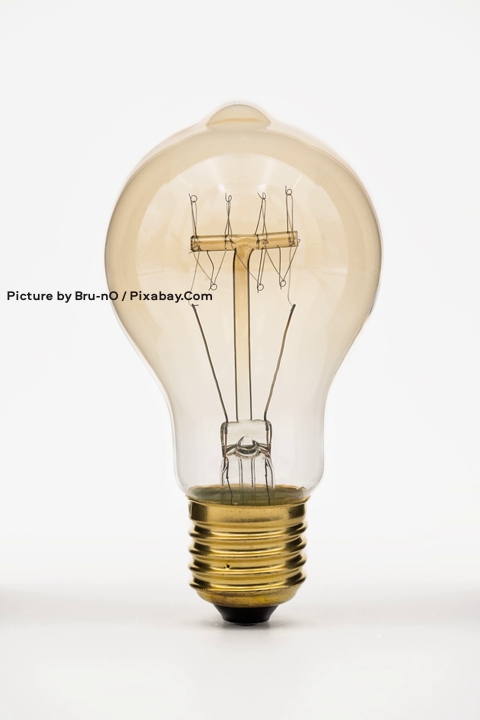
A close-up view shows a large, classic incandescent light bulb standing upright against a plain white background, its rounded, slightly amber-tinted glass envelope revealing intricate internal filaments arranged in a detailed, symmetrical structure with thin wires extending from a central support post to form loops and connections, while the lower portion features a shiny gold-colored screw base with visible threading and a black tip at the very bottom. Picture by Bru-nO / Pixabay.Com.
In the waning months of 1879, at this same Menlo Park laboratory, Edison and his team achieved a breakthrough that would forever transform human civilization. On October 21, 1879, they successfully tested an incandescent bulb with a carbonized cotton thread filament that burned for about 14.5 hours. This was not the first electric light—earlier inventors had created arc lamps and rudimentary incandescent designs—but it was the first practical one: affordable, long-lasting, safe, and scalable for everyday use.
Edison did not “invent” the light bulb in a vacuum. Pioneers like Humphry Davy (who demonstrated the electric arc in the early 1800s), Joseph Swan in Britain, and others had laid groundwork. What Edison delivered was a complete, commercially viable system. He and his team tested thousands of filament materials—everything from platinum to various carbons—before settling on a high-resistance carbon filament in a near-vacuum glass bulb. This allowed the filament to glow white-hot without quickly burning out.
On January 27, 1880, Edison received U.S. Patent No. 223,898 for his electric lamp. Later improvements, including a carbonized bamboo filament that could last over 1,200 hours, made it even more durable.
A complete system of power
Edison understood that a single bulb was useless without infrastructure. He developed dynamos for efficient electricity generation, wiring, fuses, switches, and meters—essentially the foundation of modern electrical grids. On New Year’s Eve 1879, he publicly demonstrated his system by lighting up Menlo Park, drawing crowds and media attention. By 1882, his Pearl Street Station in New York City became one of the world’s first commercial power plants, supplying electricity to dozens of customers.
Illuminating the world: Safety, productivity, and daily life
Before electric light, people relied on candles, oil lamps, and gas lighting—technologies that were dim, smoky, expensive to maintain, and dangerously flammable. Cities after dark were shadowy and hazardous; factories and homes closed with sunset. Electric lighting changed everything:
- Extended productive hours: The incandescent bulb decoupled human activity from the sun’s cycle, enabling factories to implement night shifts and operate around the clock. Industrial plants could run multiple shifts, dramatically increasing output and fueling economic growth during the Second Industrial Revolution. Offices and commercial spaces became functional well after sunset, boosting overall productivity across sectors. This extension of the workday supported higher manufacturing volumes, accelerated innovation, and contributed to the rise of a 24-hour society. The concept of “the city that never sleeps” emerged as a direct result, altering schedules for both work and leisure.
- Improved safety: Electric lighting eliminated the open flames of candles, oil lamps, and gas jets, which were major causes of fires in homes, factories, and mines. Gas lighting, in particular, produced smoke, fumes, and explosion risks, while candles posed constant fire hazards in wooden structures. Edison’s system was promoted as far safer, reducing fire-related incidents and insurance costs. Brighter, more reliable illumination also made workplaces less accident-prone—workers could see machinery and hazards clearly at night. Streets became safer for pedestrians and traffic after dark, decreasing crime and accidents. Overall, electric light enhanced public health and reduced injury risks in an increasingly industrialized world.
- Urban transformation: Electric streetlights rapidly replaced gas lamps, turning shadowy cities into well-lit metropolises. In 1880, Wabash, Indiana, became the first town in the world generally lighted by electricity with powerful arc lamps. Cities like New York installed arc lights along Broadway (the original “Great White Way”), while Edison’s incandescent systems spread to homes and businesses. Public spaces became more inviting and active at night, fostering nightlife, entertainment, and commerce. This illumination supported urbanization by making dense city living more practical and appealing. It influenced architecture (allowing deeper building designs with interior lighting), encouraged evening social gatherings, and transformed urban planning. By the 1890s, electric lighting symbolized modernity and progress, accelerating the growth of major cities and enabling expanded economic and cultural activities after dark.
Electric light contributed to longer workdays in industry, the rise of 24-hour societies, and cultural shifts—everything from evening entertainment to the ability to perform delicate surgeries at any hour. By the early 20th century, electrification reached homes across the developed world, fundamentally altering architecture, urban planning, and social norms.
Legacy and perspective
Edison’s achievement was as much about commercialization and systems engineering as pure invention. He famously said, “Genius is one percent inspiration and ninety-nine percent perspiration,” a philosophy embodied in the relentless experimentation at Menlo Park. While competitors like Swan contributed significantly (the two eventually collaborated), Edison’s vision and business acumen made electric lighting ubiquitous.
By the time of his death in 1931, Edison held over 1,000 patents and had left an indelible mark on modern life. Today, incandescent bulbs have largely been replaced by more efficient LEDs and fluorescents, but the 1879 breakthrough remains the spark that lit the modern age. It extended human potential far beyond daylight hours, illuminated knowledge and progress, and powered the electrified world we inhabit. What began as a glowing filament in a glass bulb became one of history’s most transformative technologies—turning night into day and reshaping society on a global scale.