
Cricket is a bat-and-ball sport played between two teams of eleven players on a large oval or circular field. At its center is a rectangular 22-yard (20 m) pitch with a wicket at each end—three wooden stumps topped by two small bails.
Two batters from the batting team take their positions in front of the wickets (one as striker, one as non-striker), each holding a wooden bat. A bowler from the fielding team runs in and delivers the ball toward the striker’s wicket. The striker tries to hit the ball and score runs by running with their partner to the opposite end of the pitch; each completed swap counts as one run. Additional runs come from hitting the ball to the boundary (four runs if it touches the ground, six if it clears it) or from penalties for illegal deliveries.
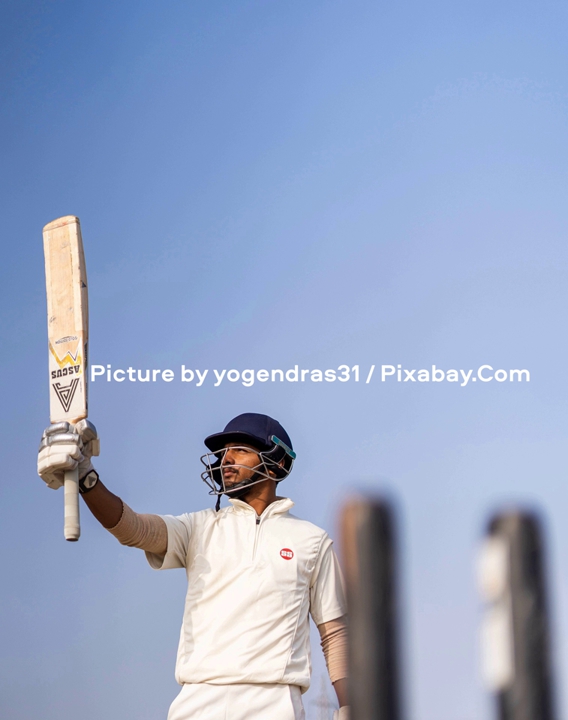
A cricket player in a white uniform stands prominently against a vibrant blue sky, his body angled slightly as he raises a wooden cricket bat high overhead with his right hand in a celebratory gesture. He wears a dark blue helmet with a metal faceguard, white batting gloves, and a watch on his left wrist, his expression focused and determined while gazing off to the side. The bat features visible logos including SS and a triangular emblem, and blurred vertical posts appear in the soft-focus background. Picture by yogendras31 / Pixabay.Com.
The fielding team’s goal is to prevent runs and dismiss (“get out”) batters. Common dismissals include bowled (ball hits the wicket and dislodges the bails), caught (fielder catches the ball before it bounces), leg before wicket (ball hits the batter’s body in front of the wicket), run out (fielder breaks the wicket while the batters are running), and stumped (wicket-keeper removes the bails while the striker is out of their crease). When ten batters are dismissed, the innings ends and the teams swap roles.
Cricket comes in many formats. Traditional Test matches last up to five days. The modern Twenty20 (T20) format limits each team to one 20-over innings and usually finishes in three to four hours. In limited-overs cricket, players wear colored team uniforms; in Tests and first-class matches, they traditionally wear all-white kit. Protective gear—helmets, pads, gloves, and a box—is essential because the ball is a hard leather-covered sphere that can travel faster than 145 km/h (90 mph).
History
Cricket evolved from medieval “club ball” games in south-east England. The earliest clear reference dates to the mid-16th century, when boys in Guildford, Surrey, were recorded playing it around 1550. The name may come from Old English or Middle Dutch words for a stick or staff. By the early 17th century it was played by adults, though Puritans sometimes banned Sunday matches.
After the Restoration in 1660, the game grew rapidly. Aristocrats and gamblers patronized high-stakes matches, and the first professional players emerged. The Hambledon Club dominated in the 1760s–80s until the Marylebone Cricket Club (MCC) and Lord’s ground took over in London.
The 19th century brought county clubs, the County Championship (1890), and international tours. England toured North America in 1859 and Australia in 1862. The first Test match was played in Melbourne in 1876–77 between England and Australia. The legendary Ashes rivalry began in 1882. W. G. Grace became the era’s biggest star, blurring the line between amateur and professional play.
The 20th century saw Australia dominate under Don Bradman, whose Test batting average of 99.94 remains unmatched. Bodyline tactics in the 1932–33 Ashes series caused a diplomatic crisis. Limited-overs cricket arrived in 1963; the first One-Day International came in 1971 and the first World Cup in 1975. T20 cricket exploded in popularity after 2003, led by the Indian Premier League (launched 2008).
Cricket spread worldwide via the British Empire and is now strongest in South Asia (especially India, Pakistan, Bangladesh, and Sri Lanka), Australia, England, the West Indies, South Africa, New Zealand, and Afghanistan. The International Cricket Council (ICC) governs the sport from Dubai and has more than 100 member nations, twelve of whom hold full Test status. The Marylebone Cricket Club in London still maintains the Laws of Cricket.
Women’s cricket has grown dramatically in the 21st century, with full international status and its own World Cups. Australia remains the most successful international side, with a record six men’s World Cup titles and consistent dominance in Tests and ODIs.
Laws and gameplay
The 42 Laws of Cricket (capital “L”) are the global rulebook, maintained by the MCC since 1788.
The field is usually oval, with a marked boundary. The central pitch is 10 ft (3 m) wide, with wickets 22 yards apart. White lines mark the bowling crease, popping crease, and return creases.
Match structure begins with a coin toss to decide who bats first. A team’s innings ends after ten wickets fall or, in limited-overs games, after the allotted overs are bowled. Test and first-class matches have two innings per side and can last up to five days; limited-overs matches finish in one day. The batting side aims to score more runs than the opposition; the fielding side tries to restrict scoring and take wickets.
Equipment: Bats are made of willow, no more than 4.25 in (10.8 cm) wide and 38 in (97 cm) long. The ball is a leather-covered cork-and-string sphere, 9 in (23 cm) in circumference. Red balls are used for day Tests, white or pink for limited-overs and day/night games. Batters and the wicket-keeper wear pads, gloves, helmets, and other protection.
Basic play involves thirteen players on the field: two batters, eleven fielders (including bowler and wicket-keeper), and two umpires. An “over” consists of six legal deliveries bowled from one end; bowlers alternate ends. Fielders position themselves according to tactics set by the captain and bowler.
Batting and scoring: Batters score by running between the creases or hitting boundaries. Extras (no-balls, wides, byes, leg byes) are awarded for fielding-side errors. A skilled batter uses a range of strokes—drives, cuts, pulls, hooks—while defending the wicket.
Dismissals (nine legal ways): bowled, caught, LBW, run out, stumped, hit wicket, hit ball twice, obstructing the field, and timed out. The fielding side must appeal (“Howzat?”) for most decisions; the umpire signals “Out” with a raised finger.
Bowling styles include fast (pace and swing), medium-pace seam, and spin (finger or wrist). Bowlers are limited to spells to avoid injury and cannot bowl two consecutive overs.
Specialist roles: The captain leads tactics and team selection. The wicket-keeper is the only fielder allowed gloves and is the only one who can stump a batter. Most teams balance specialist batters, bowlers, and all-rounders.
Match result: The side scoring more runs wins. In multi-innings games, a team can win by an innings and runs or by wickets remaining. Draws occur if time expires without a result; limited-overs games cannot draw but can tie or end as “no result.”
Spirit of cricket: Beyond the Laws, players are expected to uphold sportsmanship, fair play, and respect. Captains bear primary responsibility, but the duty extends to all participants.
Women’s cricket
First recorded in 1745 in Surrey, women’s international cricket began with a 1934 Test between England and Australia. The Women’s Cricket World Cup (1973) predates the men’s version. The ICC now treats women’s and men’s cricket equally, with dedicated rankings and global tournaments.
Governance
The International Cricket Council (ICC) is the global governing body of cricket, with its headquarters in Dubai, United Arab Emirates. Founded in 1909 as the Imperial Cricket Conference by representatives from England, Australia, and South Africa, it was renamed the International Cricket Conference in 1965 and adopted its current name in 1989. The ICC oversees all international cricket, organises major tournaments (including the Men’s and Women’s Cricket World Cups, T20 World Cup, and World Test Championship), maintains official rankings across formats, and appoints umpires and match officials. It has more than 100 member nations, twelve of which are full members eligible to play Test cricket; the remainder are associate or affiliate members with varying levels of international status. Each member country has its own national cricket board responsible for domestic cricket, team selection, and home-and-away tours.
Forms of cricket
Cricket is played in several main formats, each offering a different balance of tradition, strategy, and entertainment.
- Test and first-class cricket: These are the longest and most traditional forms. Test matches are the pinnacle of international cricket, contested over up to five days with two full innings per team using a red ball and white clothing. A draw is possible if neither side can force a result before time expires. First-class cricket is the top level of domestic competition (such as the County Championship in England or the Sheffield Shield in Australia) and follows the same rules, usually lasting three or four days.
- Limited-overs cricket: Designed to guarantee a result in a single day. One Day Internationals (ODIs) give each team 50 overs, producing balanced, tactical contests. Twenty20 (T20) limits each side to just 20 overs, creating fast-paced, high-scoring matches that typically finish in three to four hours and are especially popular with modern fans. Both formats are played at international and domestic levels.
- Shorter variants: Even quicker formats have emerged to attract new audiences. T10 cricket gives each team only 10 overs (about 90 minutes per game), while The Hundred—introduced by England in 2021—uses 100 balls per innings instead of traditional overs. These ultra-short games are often played in city-based leagues and under floodlights for maximum excitement.
Historically, single-wicket cricket (where only one batter faces every delivery) was popular in the 18th and 19th centuries but is now rarely seen.
Major competitions
International: ICC Men’s Cricket World Cup, T20 World Cup, World Test Championship, Champions Trophy, and bilateral series (most famously the Ashes).
Domestic: England’s County Championship, Australia’s Sheffield Shield, India’s Ranji Trophy and IPL, plus similar leagues worldwide.
Culture and influence
Cricket remains deeply woven into the social fabric of the Commonwealth, especially South Asia and the Caribbean, where it is a national passion. It has shaped language (“not cricket,” “sticky wicket,” “good innings”) and inspired literature, art, music, and film.
The sport also influenced other games: Australian rules football grew from cricket off-season training, several English football clubs began as cricket sides, and baseball’s box score was adapted from cricket scoring. Informal versions like street cricket and village matches keep the game alive at grassroots level everywhere it is played.
Today, with over a billion fans—most in South Asia—cricket continues to evolve while preserving the traditions that have made it one of the world’s most distinctive and enduring sports.