
The avian order Psittaciformes encompasses all parrots, one of the most recognizable and charismatic groups of birds. Commonly known as parrots or psittacines (from the type genus Psittacus), these birds are celebrated for their vivid plumage, remarkable intelligence, strong curved beaks, and often playful or vocal nature. With approximately 400–410 extant species (recent estimates place the figure around 403–410), Psittaciformes ranks among the more diverse bird orders, though it faces significant conservation challenges.
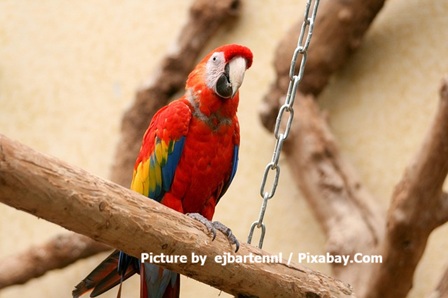
The above image captures a stunning Scarlet Macaw (Ara macao) perched confidently on a rough wooden branch, its brilliant scarlet-red plumage dominating the scene with a glossy, almost luminous quality that covers the head, chest, back, and much of the tail. Accents of vivid yellow sweep across the upper wings, blending seamlessly into deep blue flight feathers, while subtle green hints appear near the tips, creating the classic rainbow-like pattern of this iconic parrot. The bird faces slightly to the left with an alert, intelligent expression, its large dark eye framed by pale bare facial skin, a powerful curved black beak with a lighter tip, and small white feather lines radiating outward. Strong grey scaled feet grip the perch firmly, one slightly forward, while a thick metal chain hangs in the background, suggesting an aviary setting. The softly blurred earthy tones of branches and enclosure elements behind it make the macaw’s intense, jewel-like colors stand out even more dramatically. Picture by ejbartennl / Pixabay.Com.
Physical characteristics
Parrots exhibit a distinctive morphology adapted for an arboreal lifestyle. Key features include:
- A strong, curved beak with a hinged upper mandible capable of immense force (up to 35 kg/cm² or about 500 psi in large macaws), used for cracking nuts, climbing, and manipulation.
- Zygodactyl feet (two toes forward, two backward) that function almost like hands for grasping and climbing.
- An upright stance and broad wings suited for swift but often short-distance flight.
- Highly variable size: from the tiny Buff-faced Pygmy Parrot (~8 cm or ~3.1 inches long, under 10 g or ~0.35 oz) to the massive Hyacinth Macaw (~1 m or ~3.3 feet long) or heavy Kākāpō (~4 kg or ~8.8 lb).
- Bright plumage, often dominated by greens in wild species for camouflage, though many feature striking reds, blues, yellows, and whites (especially cockatoos).
Their eyes are positioned for wide fields of view, with sensitivity to ultraviolet light in some species. Parrots also possess dexterous tongues and touch-sensitive bill tips for precise food handling.
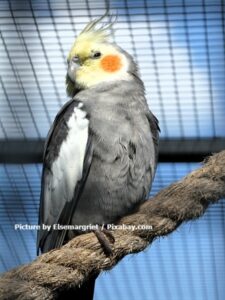
The above photograph captures a beautiful grey Cockatiel (Nymphicus hollandicus) perched confidently on a thick, textured rope branch inside its enclosure. This striking bird displays the classic wild-type coloration, with a soft silvery-grey body, crisp white flashes on its wings, and a bright yellow face accented by vivid orange cheek patches. Its expressive crest stands tall and slightly forward in a jaunty arc, adding to its alert and curious appearance as it gazes directly at the camera with dark, shiny eyes. The background shows a neat grid of blue-tinted bars, suggesting a spacious aviary or large cage, while the natural lighting highlights the subtle sheen of its feathers and the intricate barring on its tail. Picture by Elsemargriet / Pixabay.Com
Classification and taxonomy
Modern taxonomy divides Psittaciformes into four families:
- Strigopidae — New Zealand parrots (e.g., Kākāpō, Kea, Kākā; 4 species).
- Cacatuidae — Cockatoos (22 species, mostly black/white plumage with crests; centered in Australasia).
- Psittacidae — True parrots of Africa and the New World (e.g., macaws, amazons, African greys; ~179 species).
- Psittaculidae — Old World parrots (e.g., lorikeets, fig parrots, Budgerigars, Eclectus; ~203 species).
These form three superfamilies, with recent molecular studies refining relationships (e.g., lorikeets now placed within Psittaculidae).
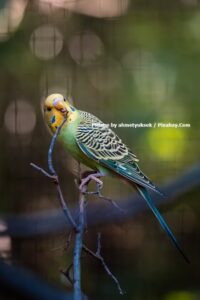
A vibrant Budgerigar (Melopsittacus undulatus) perches confidently on a thin, dry branch, its bright yellow head and face glowing warmly against the softly blurred green and brown background of an outdoor aviary. Delicate black barring patterns sweep across its cheeks and down its chest, blending into the vivid green feathers of its body, while a splash of electric blue accents the lower face and delicate throat patch. Its long, graceful tail feathers taper into a striking turquoise-blue, catching the light as they hang below the perch. The bird’s small, dark eyes peer intently forward, and its pale beak grips the twig lightly, giving the little parakeet an alert yet relaxed appearance amid the dappled natural setting. Picture by ahmetyuksek / Pixabay.Com
Distribution and habitat
Psittaciformes have a largely pantropical distribution, with highest diversity in South America and Australasia. They occupy tropical and subtropical forests, woodlands, savannas, and even alpine regions (e.g., the Kea in New Zealand’s Southern Alps). Some species have adapted to temperate zones or become feral in urban areas (e.g., Monk Parakeets in parts of North America and Europe). Most are sedentary, though a few Australian species migrate.
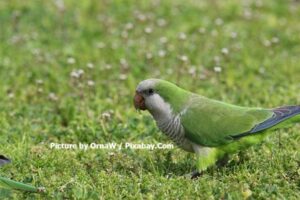
The above image shows a vibrant Monk Parakeet (Myiopsitta monachus) standing on a patch of green grass dotted with small white flowers. This small to medium-sized parrot has bright emerald-green plumage covering most of its body, including the back, wings, and tail, where the long, tapered tail feathers display hints of blue along the edges. Its face and breast feature a distinctive soft gray coloration that extends down the chest, contrasting nicely with the surrounding green tones, while the lower belly transitions to a lighter greenish-yellow shade. The bird is captured in a side profile view, with its pale pinkish bill prominently holding a small piece of food—likely a seed or nut—as it faces slightly downward toward the ground, giving a focused, natural foraging pose amid the grassy setting. Picture by OrnaW / Pixabay.Com
Behavior and intelligence
Parrots rank among the most intelligent birds, with brain-to-body ratios rivaling primates and advanced problem-solving abilities. Notable examples include the African grey parrot “Alex,” trained for nearly 30 years by animal psychologist Dr. Irene Pepperberg. Alex learned over 100 words and could use them meaningfully rather than just mimicking—he identified objects by color, shape, material, and quantity; understood concepts like “same,” “different,” “bigger,” “smaller,” “over,” and “none”; counted up to six items; and even combined labels creatively (e.g., calling an apple a “banerry” as a blend of banana and cherry). He demonstrated basic addition, inferred zero as a quantity, and was the first non-human animal documented to ask an existential question (inquiring about his own color: “What color am I?”). Pepperberg assessed his cognitive abilities as comparable to those of a 5-year-old human child (and in some areas, a 6-year-old), on par with dolphins and great apes in certain tasks. Many other species mimic sounds (via their syrinx), invent words, and engage in play. They are highly social, often forming flocks, and use tools or cooperative strategies in some cases. Arboreal climbers, they employ “tripedalism” (using beak and feet) to navigate trees.
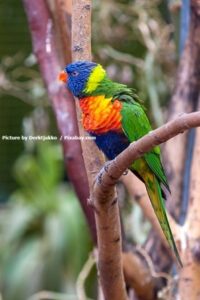
The above image captures a vibrant Rainbow Lorikeet (Trichoglossus moluccanus) perched alertly on a rough wooden branch, its striking plumage a vivid explosion of colors against the blurred natural green background of foliage. The bird features a deep blue head that transitions smoothly into a bright yellow-green collar, while its breast blazes in intense orange-red, contrasting sharply with the deep blue belly below. Emerald green covers the wings, back, and long tail feathers, accented by subtle gradients and hints of yellow along the edges, and its curved beak stands out boldly in a bright orange hue. The lorikeet’s dark eye gleams with sharpness as it grips the branch firmly with strong feet, presenting a lively and quintessential portrait of this colorful Australian parrot. Picture by Derktjakko / Pixabay.Com
Diet and reproduction
Most are granivorous or frugivorous, cracking seeds/nuts, eating fruits, buds, nectar (lorikeets with brush-tipped tongues), and occasionally insects or small animals (e.g., Kea). They are monogamous, nesting in tree hollows or burrows. Clutches are small (usually 2–5 white eggs), with prolonged parental care; young are altricial and may fledge after weeks to months. Larger species mature slowly and breed infrequently.
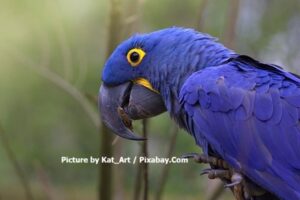
The above image captures a striking Hyacinth Macaw (Anodorhynchus hyacinthinus) in a close-up view, showcasing its vibrant cobalt-blue plumage that gleams with rich intensity across its head, neck, and body. The bird’s large, powerful beak is prominently featured as it grips a small object—likely a nut or piece of food—in its dark gray hooked bill, with subtle hints of yellow accenting the bare skin around its bright yellow eye ring and the edges near the beak. Its intense, alert eye stares forward, adding a sense of personality and focus, while part of its wing and sturdy legs gripping a branch are visible against a softly blurred natural green background of foliage, giving the scene a lively outdoor feel. Picture by Kat_Art / Pixabay.Com
Conservation and human relationships
About one-third of species are threatened, driven by habitat loss, illegal pet trade, hunting, and invasives—higher risk than most bird groups. Nineteen species have gone extinct since 1500 (e.g., Carolina Parakeet). International regulations (CITES) and captive breeding help, with successes like the Kākāpō’s recovery from ~50 to over 240 individuals.
Parrots have captivated humans for millennia, appearing in art, mythology, and as pets (millions in captivity worldwide). Their mimicry, affection, and longevity make them popular companions, though they require substantial care and stimulation. Escaped pets have established feral populations in non-native areas.
Psittaciformes stand out for their combination of beauty, brains, and adaptability—traits that make them both beloved and vulnerable in the modern world.