
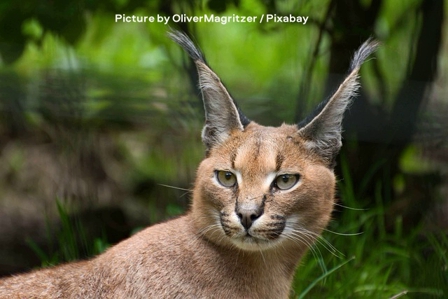
The Caracal (Caracal caracal), often called the Desert Lynx, is a striking wild felid native to Africa, the Middle East, Central Asia, and parts of India. Known for its sleek build, tufted ears, and remarkable agility, this medium-sized felid captivates wildlife enthusiasts and researchers alike. Its name, derived from the Turkish word “karakulak” meaning “black ear,” reflects its most distinctive feature: long, black-tufted ears that enhance its acute hearing. With three recognized subspecies—C. c. caracal (Southern and East Africa), C. c. nubicus (North and West Africa), and C. c. schmitzi (Asia)—the Caracal occupies diverse regions, from arid savannas to scrublands.
Physical characteristics
The Caracal is a slender, medium-sized felid with a robust yet elegant frame. Adults typically measure 61–101 cm (2’0”–3’3”) in body length, with a tail of 18–34 cm (7”–1’1”). They stand 38–50 cm (1’3”–1’8”) at the shoulder and weigh 8–19 kg (18–42 pounds), with males generally larger than females. Their short, dense coat ranges from reddish-brown to tawny, with a lighter underbelly. The Caracal’s black ear tufts, up to 4.5 cm (1.8”) long, and facial markings add to its distinctive appearance, while its long, powerful legs enable spectacular leaps, reportedly up to 3 meters (10’) to catch birds in mid-flight.
| Class | Mammalia |
| Order | Carnivora |
| Family | Felidae |
| Genus | Caracal |
| Species | C. caracal |
| Binomial Name | Caracal caracal |
| Length | 61–101 cm (2’0”–3’3”) |
| Tail Length | 18–34 cm (7”–1’1”) |
| Shoulder Height | 38–50 cm (1’3”–1’8”) |
| Weight | 8–19 kg (18–42 pounds) |
| IUCN Status | Least Concern |
Habitat and distribution
Caracals thrive in diverse habitats, including savannas, grasslands, scrublands, and semi-deserts, preferring areas with some cover for hunting. They are widely distributed across sub-Saharan Africa, North Africa, the Middle East, Central Asia, and parts of India, with notable regional populations. In North Africa, Caracals are rare, with populations close to extinction in countries like Morocco, Algeria, and Tunisia due to habitat loss and human encroachment. Elsewhere, their range includes:
- South Africa (stable, widespread): Found in the Eastern Cape (highest population, especially in mountainous areas), Northern Cape (semi-arid savannas), and Western Cape (sightings near Cape Town).
- Namibia (abundant): Present in Khomas (savannas around Windhoek), Erongo (scrublands), and Hardap (low-rainfall areas).
- Ethiopia: Occurs in Tigray (Degua Tembien massif), Amhara (montane habitats), and Oromia (semi-arid regions).
- Kenya: Common in Laikipia (grasslands), Kajiado (scrublands), and Narok (Maasai Mara ecosystems).
- Iran (declining): Found in Fars (Bahram’gur Protected Area), Isfahan (Abbasabad Naein Reserve), and Kerman (arid habitats).
- United Arab Emirates (rare): Recorded in Abu Dhabi (Jebel Hafeet National Park) and Dubai (desert areas).
- Turkey (near-endangered): Present in Antalya, Muğla, and Izmir (wildlife reserves and Mediterranean woodlands), with very rare populations facing threats from habitat loss and human activities.
- Israel: Found in the Southern District (Negev Desert) and Central District (semi-arid regions).
- Uzbekistan (Critically Endangered): Rare in Karakalpakstan (arid regions), Navoiy (steppe habitats), and Bukhara (Badhyz State Nature Reserve).
- Turkmenistan (rare): Present in Balkan and Lebap (Badhyz Reserve) and Dashoguz (desert habitats).
- India (Critically Endangered, <50 individuals): Found in Rajasthan (Ranthambore and Mukundra Hills Tiger Reserves), Gujarat (Kachchh district), and Madhya Pradesh (Chambal River area).
Their adaptability to arid environments and ability to survive with minimal water make them resilient, though populations in North Africa, Pakistan, and parts of Asia are rare or declining.
Behavior and hunting
Caracals are solitary, nocturnal hunters, though they may be active at dawn or dusk in cooler regions. Their exceptional agility and strength allow them to tackle antelopes up to three times their size. Their signature hunting technique—leaping high to snatch birds from the air—sets them apart from other felids. Caracals are territorial, marking their range with scent and communicating through hisses, growls, and purrs. Males typically have larger territories, overlapping those of several females.
Diet
The Caracal’s diet is varied, reflecting its opportunistic nature. Small mammals like rodents and hares form the bulk of its prey, but it also hunts birds, reptiles, and occasionally larger animals like young antelopes. In regions like Kenya’s Laikipia or South Africa’s Northern Cape, Caracals may prey on livestock, leading to rare conflicts with farmers.
Reproduction
Caracals breed year-round, with females giving birth to 1–6 kittens after a gestation period of 68–81 days. Kittens are born blind and helpless, opening their eyes within 10 days. The mother raises them alone, weaning them at around 10–15 weeks. By 9–12 months, young Caracals reach independence, though they may remain in their mother’s territory for a short time before dispersing.
Conservation status
The Caracal is listed as Least Concern by the IUCN, with stable populations in southern and eastern Africa (e.g., South Africa’s Eastern Cape, Namibia’s Khomas). However, localized threats persist, including habitat loss in India’s Rajasthan, human-wildlife conflict in Israel’s Southern District, and poaching in Iran’s Fars province. In North Africa and Central Asia (e.g., Uzbekistan’s Karakalpakstan), populations are critically endangered or near extinction. In Turkey, the near-endangered status reflects their very low numbers and ongoing threats. Conservation efforts focus on mitigating conflicts and protecting habitats, particularly in reserves like India’s Ranthambore and Turkmenistan’s Badhyz.
Cultural significance
In various cultures, the Caracal holds symbolic value. In ancient Egypt, Caracals were revered and depicted in art. In parts of Asia, such as Turkey’s Antalya, their agility made them prized for hunting small game historically. Today, they remain a symbol of grace and adaptability, especially in regions like Ethiopia’s Tigray or India’s Gujarat, where their rarity adds to their mystique.
The Caracal’s blend of beauty, athleticism, and resilience makes it a remarkable felid. Its ability to thrive in diverse environments—from South Africa’s savannas to Iran’s deserts—and captivate observers ensures its place as one of nature’s most fascinating felids.