
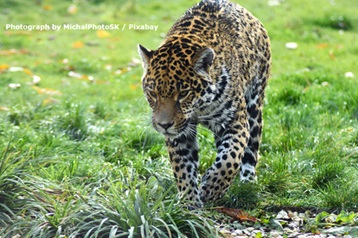
The Jaguar(Panthera onca) is one of the most iconic and powerful big cats in the world, revered for its strength, beauty, and mystique. As the largest cat in the Americas and the only member of the Panthera genus native to the region, the Jaguar holds a significant place in both ecosystems and cultural histories. This article explores the Jaguar’s biology, habitat, behavior, cultural significance, and conservation challenges.
| Genus | Panthera |
| Species | P. onca |
| Binomial Name | Panthera onca |
| Length | 1.1-1.9 m(3’7”-6’3”) |
| Tail Length | 45-75 cm(1’6”-2’5”) |
| Weight | 36-158 kg(79-348 lbs.) |
| DIet | Carnivore |
| IUCN Status | Near threatened |
Physical Characteristics
Jaguars are robust, muscular cats with a distinctive appearance. Their coat is typically a tawny yellow with black rosettes, though melanistic (black) Jaguars are common in certain populations, particularly in dense forests. These black Jaguars, often called “Black Panthers,” are not a separate species but rather a color variation caused by a genetic mutation.
Size And Weight: The average weight of a Jaguar is 81 kilograms(179 pounds). Jaguars in the Pantanal region of Brazil can grow significantly larger, with some males reaching up to 135 kilograms (300 pounds), while those in Central America tend to be smaller.
Build: Jaguars have a stocky, powerful build with short, sturdy legs and a large head. Their bite force is among the strongest of all big cats, capable of crushing turtle shells and piercing skulls, a trait that sets them apart from other felids.
Habitat And Distribution
Jaguars are highly adaptable and inhabit a variety of environments across Central and South America, from rainforests and swamps to grasslands and scrublands. Their range once extended from the southwestern United States to southern Argentina, but habitat loss has reduced their presence in many areas. Today, they are primarily found in the Amazon Basin, the Pantanal, and parts of Central America.
Preferred Habitats: Jaguars thrive in dense forests and wetlands, often near rivers and swamps, as they are excellent swimmers. They are also found in drier regions like savannas, though they avoid extreme deserts and high mountains.
Current Range: The largest populations are in Brazil, Bolivia, and Peru, with smaller, fragmented populations in Mexico, Central America, and northern Argentina. Jaguars are considered extirpated in the United States, though occasional sightings occur near the Mexican border.
Behavior And Ecology
Jaguars are solitary, apex predators known for their stealth and strength. They are opportunistic hunters with a diverse diet, preying on over 80 species, including deer, peccaries, capybaras, caimans, and even anacondas. Their powerful jaws allow them to tackle prey that other big cats might avoid, such as armored reptiles.
Hunting Style: Jaguars are ambush predators, relying on their camouflage and stealth to stalk prey. Unlike many cats, they often kill by biting through the skull, targeting the brain, which is an efficient and lethal technique.
Territoriality: Males maintain large territories, which can span 20-100 square miles (50-260 sq km), depending on prey availability. Females have smaller ranges, and territories often overlap. Jaguars mark their territories with scent, claw marks, and vocalizations, including deep roars.
Reproduction: Jaguars have no specific breeding season, but mating is more common during periods of abundant prey. After a gestation period of about 90-110 days, females give birth to 1-4 cubs, which stay with their mother for up to two years before becoming independent.
Cultural Significance
The Jaguar is a cultural icon in many Latin American countries, appearing in national emblems, sports teams, and conservation campaigns.
Conservation Status And Threats
The Jaguar is listed as Near Threatened on the IUCN Red List, with populations declining due to habitat loss, human-wildlife conflict, and poaching. Major threats include:
Deforestation: The destruction of rainforests for agriculture, logging, and infrastructure reduces Jaguar habitat and fragments populations.
Human Conflict: As Jaguars lose habitat, they sometimes prey on livestock, leading to retaliatory killings by ranchers.
Poaching: Jaguars are hunted for their pelts, bones, and other body parts, particularly in illegal wildlife trade networks.
Conservation efforts are underway to protect Jaguars, including:
Protected Areas: National parks and reserves, such as Brazil’s Pantanal and Bolivia’s Madidi National Park, provide critical habitat.
Corridors: Initiatives like the Jaguar Corridor Initiative aim to connect fragmented habitats across countries, allowing Jaguars to move and maintain genetic diversity.
Community Engagement: Programs that compensate farmers for livestock losses or promote ecotourism help reduce human-Jaguar conflict.
Fun Facts
Jaguars are one of the few big cats that regularly swim and hunt in water, often catching fish or caimans.
The name “Jaguar” comes from the indigenous Tupi-Guarani word yaguara, meaning “beast that kills with one leap.”
Unlike most cats, Jaguars do not avoid water and are known to cross rivers and swim long distances.
Conclusion
The Jaguar is a remarkable predator, embodying the wild spirit of the Americas. Its strength, adaptability, and cultural significance make it a vital part of both ecosystems and human heritage. However, ongoing threats highlight the need for continued conservation efforts to ensure this majestic cat thrives for generations to come. By protecting Jaguars and their habitats, we preserve not only a keystone species but also a symbol of the untamed beauty of the natural world.