
The Elimination Chamber is one of the most intense and innovative match types in professional wrestling, created and popularized by WWE. Known for its punishing steel structure and high-stakes format, it places multiple competitors inside a massive enclosed cage where only the last participant standing emerges victorious. The match combines elements of endurance, strategy, and raw physicality, making it a fan-favorite spectacle that tests Superstars to their absolute limits.
Origins and concept
The Elimination Chamber was conceived in 2002 as a fresh, high-impact alternative to existing match types. It draws inspiration from formats like Hell in a Cell, the Royal Rumble, and Survivor Series, while incorporating aspects of World Championship Wrestling’s WarGames. Triple H is widely credited with developing the core idea, and Eric Bischoff, serving as Raw General Manager at the time, formally introduced the concept on television. The match was designed to deliver unpredictable chaos through timed entries, a towering steel cage, and strict elimination rules.
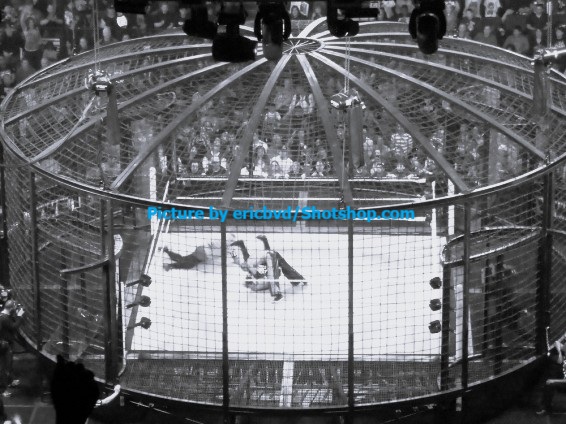
The picture above captures the iconic WWE Elimination Chamber, a massive and intimidating circular steel structure that completely encloses the wrestling ring like a sinister cage designed for chaos. The imposing framework rises high with thick chain-link walls and a domed roof made of interconnected metal beams and mesh panels, creating a claustrophobic arena where escape is impossible. At each corner of the central ring stand four transparent bulletproof pods, cylindrical chambers mounted on the structure’s perimeter, where superstars wait in tense isolation before being released into the fray at timed intervals. Bright arena lights reflect off the gleaming metal and glass, casting dramatic shadows across the empty ring mat below, emphasizing the brutal, unforgiving nature of the match that will soon unfold inside this mechanical monstrosity surrounded by roaring crowds. Picture by ericbvd/Shotshop.com.
The inaugural Elimination Chamber match debuted at Survivor Series 2002 at Madison Square Garden in New York City. It was a six-man contest for the World Heavyweight Championship featuring Triple H (the defending champion, accompanied by Ric Flair), Rob Van Dam, Chris Jericho, Booker T, Kane, and Shawn Michaels. This was Shawn Michaels’ return match after a four-year hiatus, adding significant drama to the encounter centered around his long-standing rivalry with Triple H.
The match lasted 39 minutes and 20 seconds, with competitors released from their pods every five minutes. Triple H and Rob Van Dam started the action inside the ring. Key highlights included Rob Van Dam’s daring Five-Star Frog Splash from atop a pod onto Triple H, Kane hurling Chris Jericho through a plexiglass pod (a memorable early use of the structure), and intense teamwork and betrayals among the competitors.
Eliminations occurred as follows: Booker T pinned Rob Van Dam with a Missile Dropkick at 13:37 after Van Dam’s high-risk move; Chris Jericho eliminated Booker T with a Lionsault at 17:40; Kane was eliminated at 22:53 after a combination of Sweet Chin Music from Michaels, a Pedigree from Triple H, and a Lionsault from Jericho; Shawn Michaels pinned Chris Jericho with Sweet Chin Music at 30:43; and finally, Michaels pinned Triple H with another Sweet Chin Music at 39:20 to win the World Heavyweight Championship.
Shawn Michaels emerged victorious in this groundbreaking contest, which immediately showcased the match’s potential for dramatic eliminations, high-risk maneuvers, and intense rivalries. This debut established the Elimination Chamber as a signature WWE creation, emphasizing both spectacle and the severe physical demands placed on participants.
Structure and design
The Elimination Chamber is defined by its imposing steel structure, a circular (later square) cage that surrounds the ring entirely. The original design stood 16 feet high with a 36-foot diameter and weighed over 10 tons, incorporating two miles of chain links. Four transparent plexiglass pods are positioned at the corners, each capable of holding one competitor.
In 2017, WWE updated the structure to a square configuration for improved arena compatibility. The revised version reaches 26 feet in height, features sliding pod doors, padded flooring for added safety, and integrated LED lighting for enhanced visual impact. These modifications maintain the match’s intimidating presence while improving both competitor safety and audience viewing experience.
Rules and format
A standard Elimination Chamber match involves six participants (though variations with more or fewer competitors have occurred). The contest begins with two Superstars in the ring, while the remaining four are locked inside the pods. Every five minutes, one pod opens at random, releasing its occupant into the fray until all competitors are active.
Eliminations can only occur via pinfall or submission, and there are no disqualifications or count-outs. Since 2010, all eliminations must take place inside the ring itself. The grated metal platform surrounding the ring adds an extra layer of danger, enabling high-risk maneuvers and the use of the chains and structure as improvised weapons.
The last Superstar (or team, in tag team variants) remaining is declared the winner. The match is frequently used to determine championships or earn championship opportunities at major events, particularly WrestleMania.
Match variations
While the classic six-person singles format remains the most common, WWE has introduced several variations over the years:
- Tag team Elimination Chamber matches, where teams compete for tag team championships.
- Seven-person versions, expanding the field for greater unpredictability.
- Extreme or weapon-enhanced editions, with tools like steel chairs, tables, or other objects placed inside the pods.
Women’s Elimination Chamber matches have also become a regular feature, showcasing top female competitors in the same grueling environment.
Legacy and appeal
The Elimination Chamber has earned its reputation as one of WWE‘s most physically demanding and visually striking match types. Its enclosed steel environment creates a sense of inescapable pressure, forcing competitors to confront both their opponents and the unforgiving structure itself. High-risk dives, chain-assisted attacks, and dramatic pod entries contribute to its reputation for unforgettable moments.
With its combination of timed drama, multiple participants, and brutal physicality, the Elimination Chamber continues to stand out as a premier contest in professional wrestling, delivering intense action and high-stakes competition every time it is contested.