
The Super Bowl stands as the pinnacle of American professional football, an annual championship game that crowns the National Football League (NFL) champion. What began as a modest interleague matchup in the 1960s has evolved into a global spectacle, blending high-stakes athletics with entertainment, commerce, and cultural traditions. Held every February since 2022 on the second Sunday of the month, the event draws over 100 million viewers in the U.S. alone, making it one of the most-watched broadcasts worldwide. This article explores the Super Bowl’s origins, key milestones, and transformation into a cultural juggernaut.
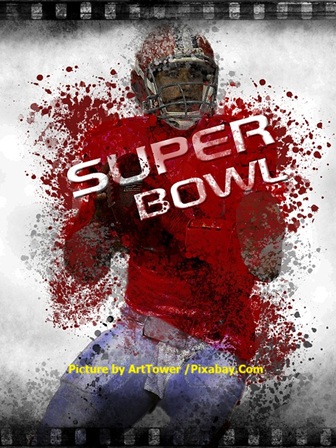
The image above depicts a dramatic and intense football-themed poster with a player in a red jersey and helmet captured in a dynamic, aggressive pose, his arm thrust forward as if delivering a powerful punch or charge, surrounded by bold red splatters that evoke blood or exploding energy against a grayscale background for stark contrast. The word “SUPER BOWL” is prominently overlaid in large, stylized white letters with matching red splatter effects, giving the composition a high-energy, cinematic vibe reminiscent of action movie promotions, framed by black filmstrip borders at the top and bottom to enhance the theatrical feel. Picture by ArtTower / Pixabay.Com.
Origins: The AFL-NFL rivalry and merger
The Super Bowl’s roots trace back to the competitive landscape of American football in the mid-20th century. The NFL, founded in 1920 as the American Professional Football Association, dominated the sport for decades. However, in 1960, a group of businessmen led by Lamar Hunt—frustrated by the NFL’s reluctance to expand—formed the American Football League (AFL). The AFL emphasized a more exciting, pass-heavy style of play, attracting fans and talent away from the established league.
By 1966, the rivalry had escalated into a bidding war for players, prompting secret merger negotiations. NFL Commissioner Pete Rozelle and Hunt agreed to unify the leagues by 1970, but in the interim, they created an end-of-season championship game between the AFL and NFL winners. This contest, initially called the AFL-NFL World Championship Game, aimed to determine a true national champion.
The first game was played on January 15, 1967, at the Los Angeles Memorial Coliseum. The NFL’s Green Bay Packers, coached by Vince Lombardi, defeated the AFL’s Kansas City Chiefs 35-10 before a crowd of about 61,000—far from a sellout, with tickets averaging $12. Broadcast simultaneously on CBS and NBC, it marked the beginning of the Super Bowl era, though the name wasn’t official yet.
Naming, symbols, and early traditions
The term “Super Bowl” originated from Hunt, who drew inspiration from his children’s “Super Ball” toy during merger talks. He mentioned it casually in a 1966 letter to Rozelle, and sportswriters popularized it. It became official for the third game in 1969, with the first two retroactively renamed.
Roman numerals were introduced for Super Bowl V in 1971 to avoid confusion between the calendar year and the season it concludes (e.g., Super Bowl LX in 2026 caps the 2025 season). An exception was Super Bowl 50 in 2016, which used Arabic numerals for marketing. The winning team receives the Vince Lombardi Trophy, renamed in 1970 after the legendary Packers coach who won the first two games.
Early halftime shows featured marching bands and simple entertainment, like trumpeter Al Hirt in Super Bowl I. Logos evolved from colorful, host-city-themed designs in the 1990s to more standardized, corporate styles in recent years.
Early years: From skepticism to legitimacy (1967-1979)
The Packers dominated the inaugural games, winning Super Bowl II (33-14 over the Oakland Raiders) as well. Skeptics viewed the AFL as inferior, but Super Bowl III in 1969 changed that. New York Jets quarterback Joe Namath famously “guaranteed” victory over the heavily favored Baltimore Colts, delivering a 16-7 upset that validated the AFL. The Chiefs followed with a 23-7 win in Super Bowl IV, evening the pre-merger record at 2-2.
Post-merger in 1970, the NFL realigned into the AFC (mostly ex-AFL teams) and NFC (mostly ex-NFL). The 1970s saw dynasties emerge: the Miami Dolphins achieved the only perfect season (17-0) in 1972-73, winning Super Bowls VII and VIII. The Pittsburgh Steelers, with their “Steel Curtain” defense, won four titles (IX, X, XIII, XIV) in six years, establishing the decade’s dominance.
| Decade | Key Winners | Notable Achievements |
|---|---|---|
| 1960s | Packers (I, II), Jets (III), Chiefs (IV) | AFL gains credibility with upsets |
| 1970s | Steelers (4 wins), Dolphins (2), Cowboys (2) | First post-merger dynasties |
The NFC era: Dominance and innovation (1980s-1990s)
The 1980s and 1990s belonged to the NFC, which won 13 straight Super Bowls from 1985 to 1997. The San Francisco 49ers revolutionized the game with Bill Walsh’s West Coast offense, securing four titles (XVI, XIX, XXIII, XXIV) led by Joe Montana and Jerry Rice. Their 55-10 rout of the Denver Broncos in Super Bowl XXIV remains the largest margin of victory.
The Dallas Cowboys added three wins in the 1990s (XXVII, XXVIII, XXX), forming the “Triplets” with Troy Aikman, Emmitt Smith, and Michael Irvin. The Buffalo Bills famously lost four consecutive Super Bowls (XXV-XXVIII), highlighting the era’s NFC supremacy.
The modern era: Parity, dynasties, and records (2000s-present)
The 2000s saw the AFC resurgence, led by the New England Patriots under Tom Brady and Bill Belichick. They won three of the first four (XXXVI, XXXVIII, XXXIX), including a dramatic last-second field goal in XXXVI. The Patriots’ near-perfect 2007 season (18-1) ended in a stunning Super Bowl XLII loss to the New York Giants, featuring David Tyree’s “Helmet Catch.”
The 2010s continued the Patriots’ reign with four more wins (XLIX, LI, LIII, and Brady’s seventh with the Tampa Bay Buccaneers in LV). Super Bowl LI’s 28-3 comeback overtime victory over the Atlanta Falcons set the record for largest deficit overcome. The 2020s have spotlighted the Kansas City Chiefs, who won three titles (LIV, LVII, LVIII), including back-to-back in 2023-24. In Super Bowl LIX (2025), the Philadelphia Eagles defeated the Chiefs 40-22.
The Steelers and Patriots share the record with six wins each, while the Patriots have the most appearances (11). Four teams—the Cleveland Browns, Detroit Lions, Houston Texans, and Jacksonville Jaguars—have never appeared.
Broadcasting, commercialism, and cultural impact
Broadcasting rotated among networks starting with CBS and NBC, expanding to Fox and ABC. Viewership exploded: Super Bowl LVIII in 2024 averaged 123.7 million U.S. viewers, with the halftime show peaking at 129.2 million. Globally, it reaches over 200 countries, though most viewers are in North America.
Evolution of halftime shows
The halftime show has transformed from modest university marching band performances and variety acts in the early years to star-studded extravaganzas that often rival the game in popularity. For the first two decades, shows featured groups like Up with People, Grambling State University Marching Band, and themed productions tied to Disney or local culture. A pivotal shift occurred in 1993 with Michael Jackson‘s performance at Super Bowl XXVII, which boosted ratings and set a new standard for pop culture integration. Jackson’s set, including hits like “Billie Jean” and “Heal the World,” drew massive viewership and marked the beginning of headline acts by major artists.
Subsequent shows featured arena rock bands and pop icons, such as U2 in 2002 (Super Bowl XXXVI), which included a poignant 9/11 tribute, and Prince in 2007 (Super Bowl XLI), whose rain-soaked rendition of “Purple Rain” is often hailed as the greatest halftime performance ever. Other memorable acts include Beyoncé in 2013 (Super Bowl XLVII), reuniting Destiny’s Child; Lady Gaga in 2017 (Super Bowl LI) with acrobatic elements; and the 2022 hip-hop collective of Dr. Dre, Snoop Dogg, Eminem, Mary J. Blige, and Kendrick Lamar (Super Bowl LVI).
Recent years have seen continued innovation: Rihanna’s 2023 aerial performance (Super Bowl LVII) revealed her pregnancy, Usher’s 2024 roller-skating spectacle (Super Bowl LVIII) featured guests like Alicia Keys, and Kendrick Lamar with SZA in 2025 (Super Bowl LIX) set viewership records at 133.5 million. Not without controversy, Janet Jackson and Justin Timberlake’s 2004 “wardrobe malfunction” (Super Bowl XXXVIII) led to FCC fines and a shift toward safer productions. Since 2019, Jay-Z’s Roc Nation has partnered with the NFL to curate shows, emphasizing diversity and cultural relevance. For Super Bowl LX in 2026, Bad Bunny is set to headline.
Iconic Super Bowl commercials
Commercials have become a hallmark of the Super Bowl, with brands paying premium rates—up to $7 million for 30 seconds by 2022—to premiere innovative ads that often become cultural touchstones. These spots leverage humor, celebrity endorsements, and emotional storytelling to captivate audiences, sometimes overshadowing the game itself.
Early classics include Coca-Cola’s 1980 “Hey Kid, Catch” featuring “Mean” Joe Greene, which epitomized heartfelt advertising. Apple’s dystopian “1984” ad, directed by Ridley Scott and aired during Super Bowl XVIII, introduced the Macintosh computer and revolutionized tech marketing. Wendy’s 1984 “Where’s the Beef?” with Clara Peller became a catchphrase, mocking competitors’ burgers.
The 1990s and 2000s brought star power: Pepsi’s 1992 “New Can” with Cindy Crawford, McDonald’s 1993 “Showdown” pitting Michael Jordan against Larry Bird, Volkswagen’s 2011 “The Force,” showing a child as Darth Vader, amassed millions of pre-game views online. More recent hits include Google’s 2010 “Parisian Love,” a simple search story; and Jeep’s 2020 “Groundhog Day” revival with Bill Murray.
Humor persists in spots like Snickers’ 2010 “You’re Not You When You’re Hungry” with Betty White, and Doritos’ user-generated contests yielding viral ads. These commercials not only boost brand recall but also spark social media buzz, extending their impact far beyond the broadcast.
Traditions include the national anthem, coin tosses by dignitaries, and post-game Disney ads.
Culturally, it’s the second-largest U.S. food consumption day after Thanksgiving, with fans spending heavily on snacks. The NFL‘s trademark on “Super Bowl” has led to creative workarounds like “the big game” in ads.
Conclusion: A lasting legacy
From a half-empty stadium in 1967 to a billion-dollar extravaganza, the Super Bowl has mirrored American culture’s evolution—embracing innovation, spectacle, and commercialization while showcasing athletic excellence. As it approaches Super Bowl LX in 2026 at Levi’s Stadium, the event continues to adapt, with recent expansions like a 17-game season and international games signaling further growth. What started as a merger experiment has become an indelible part of global sports history.