
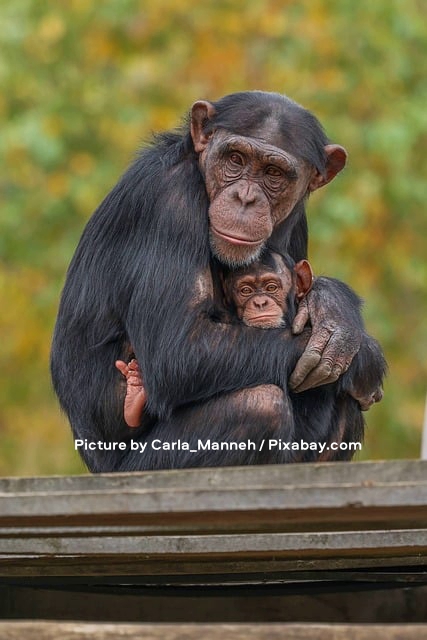
The above mage captures a tender moment between a mother Chimpanzee (Pan troglodytes} and her young infant in what appears to be a natural outdoor enclosure. The adult Chimpanzee, with dark glossy fur and expressive brown eyes, sits upright on a wooden structure, cradling her small baby protectively against her chest. The infant clings tightly to its mother, one tiny hand gripping her arm while its face peeks out, gazing directly at the camera with a calm, curious expression. The background features soft autumnal foliage in warm shades of yellow and green, creating a peaceful, naturalistic setting. Picture by Carla_Manneh / Pixabay.com.
The mammalian order Primates represents one of the most diverse and fascinating groups within Class Mammalia. With over 500 recognized living species, it ranks as the third most diverse order of mammals, behind rodents (Rodentia) and bats (Chiroptera). This order includes lemurs, lorises, tarsiers, monkeys, apes, and humans (Homo sapiens), making it the group to which we ourselves belong.
Primates are predominantly arboreal (tree-dwelling) animals, though many species have adapted to terrestrial, semi-terrestrial, or even highly specialized lifestyles. They are native mostly to tropical and subtropical regions of Africa, Asia, Central and South America, with some exceptions like certain lemurs in Madagascar or monkeys in more temperate zones.
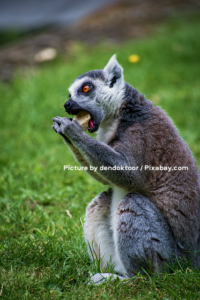
The above image shows a Ring-tailed Lemur (Lemur catta) sitting upright on a patch of green grass, intently eating a piece of food it is holding tightly in both hands. Its distinctive black-and-white striped tail is curled around its body, while its large orange-red eyes are wide open and focused on the food. The Ring-tailed Lemur’s mouth is open, revealing teeth as it takes a bite, giving it a lively and slightly comical expression. The background is a softly blurred natural outdoor setting with green grass and hints of foliage. Picture by dendoktoor / Pixabay.ca
Key characteristics of Primates
Primates share several distinctive anatomical and behavioral traits that set them apart from other mammals, many of which are adaptations to life in trees:
- Forward-facing eyes — providing stereoscopic vision (depth perception), crucial for judging distances when leaping or grasping branches.
- Grasping hands and feet — with opposable thumbs and often opposable big toes, along with flat nails (instead of claws) and sensitive fingertips.
- Large brain relative to body size — especially in the neocortex, supporting complex cognition, problem-solving, and social intelligence.
- Reduced olfactory sense — compared to many mammals, with a corresponding emphasis on vision.
- Slow life history — longer gestation periods, extended parental care, later sexual maturity, and longer lifespans.
- Generalized dentition — teeth suited for a varied diet rather than highly specialized feeding.
Many of these traits are connected with arboreal locomotion and enhanced visual processing.
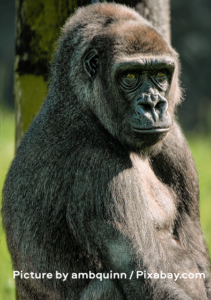
The above image shows a close-up portrait of a large adult gorilla, sitting outdoors in what appears to be a natural or semi-natural enclosure. Its thick, dark gray-black fur covers a powerfully built body and shoulders, while the face displays a calm, direct gaze with deep-set dark eyes, a broad flat nose, and a thoughtful expression. The gorilla rests against a tree trunk, with soft green foliage visible in the blurred background, giving the scene a quiet, contemplative atmosphere. Picture by ambquinn . Pixabay.Com
Classification of Primates
Modern classification divides the order Primates into two suborders: Strepsirrhini and Haplorhini. These suborders differ in several key features, including nose structure, sensory emphasis, activity patterns, and other anatomical traits.
- Strepsirrhini (wet-nosed primates, also called strepsirrhines)
Strepsirrhini includes lemurs (mostly endemic to Madagascar), lorises (found in parts of Africa and Asia), galagos (also known as bushbabies, primarily in sub-Saharan Africa), and pottos (slow-moving primates of African forests).
They are characterized by a wet rhinarium (a moist, naked nose tip similar to that of dogs or cats), which supports a strong sense of smell. Many possess a dental comb (forward-projecting lower incisors and canines used for grooming and feeding) and a grooming claw (or “toilet claw”) on the second toe of the foot, specialized for grooming and cleaning.
Most strepsirrhines are nocturnal or cathemeral (active at various times), with large eyes adapted for low-light vision. They tend to have smaller brains relative to body size compared to the other suborder and rely more heavily on olfaction. Many are highly arboreal, with leaping or slow, deliberate climbing styles. Lemurs show particularly high diversity in Madagascar, ranging from tiny mouse lemurs to larger indriids, while lorises and galagos are known for their distinctive calls and insectivorous or frugivorous diets. - Haplorhini (dry-nosed primates, also called haplorhines)
Haplorhini includes tarsiers (small, nocturnal primates of Southeast Asian islands), monkeys (New World and Old World), apes (such as gibbons, orangutans, gorillas, chimpanzees, and bonobos), and humans.
They have dry noses without a prominent rhinarium, reduced reliance on smell, and a greater emphasis on vision. Haplorhines generally have larger brains relative to body size, more advanced visual systems (including a postorbital plate for eye protection), and fused lower jaw halves in many groups.
Activity patterns vary widely: tarsiers are strictly nocturnal with enormous eyes that do not move in their sockets (they rotate their heads nearly 180 degrees instead), while most monkeys and apes are diurnal. Haplorhines lack the dental comb and grooming claw of strepsirrhines. Tarsiers are unique in their vertical clinging and leaping locomotion, while monkeys and apes show diverse adaptations, from arboreal to fully terrestrial lifestyles.
Haplorhini is further split into:
- Tarsiiformes (tarsiers)
- Anthropoidea (monkeys, apes, humans), which includes New World monkeys (Platyrrhini), Old World monkeys (Cercopithecoidea), and apes/humans (Hominoidea).
Diversity and conservation
Today, primates range from tiny mouse lemurs (~30 grams) to large gorillas and orangutans (up to 200 kg). They occupy varied niches—from solitary nocturnal foragers to highly social, diurnal groups.
Many species face severe threats from habitat loss and hunting. Over half of primate species are currently classified as threatened with extinction, making conservation efforts critical.
In summary, the order Primates showcases remarkable features in vision, dexterity, intelligence, and social behavior—traits that characterize one of the most cognitively advanced groups of mammals on Earth, including our own species.