
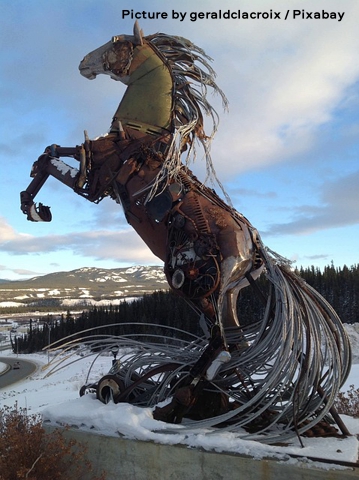
The image shows “The Horse of Whitehorse,” a striking public art sculpture located in Whitehorse, Yukon Territory, Canada. Created by artist Daphne Mennell and unveiled in 2016, this monumental rearing stallion is constructed entirely from reclaimed scrap metal, including gears, chains, pipes, bolts, and twisted steel cables that form its flowing mane and tail.Key details: The horse stands powerfully on its hind legs, forelegs raised high, head arched back in a dynamic, energetic pose that captures the wild spirit of the Yukon.The mane and tail are made of long, cascading metal cables, giving the impression of wind-whipped motion even in stillness. Its body is a masterful weld of rusted and polished industrial parts, blending raw mechanical texture with the graceful form of a horse. The sculpture is mounted on a concrete pedestal beside the Alaska Highway, surrounded by a snowy landscape with dense evergreen forests and distant snow-capped mountains under a vast northern sky. “The Horse of Whitehorse” has become an iconic landmark, symbolizing strength, freedom, and the resourceful spirit of the Yukon. Photo credit: geraldclacroix / Pixabay
Stretching across 482,443 square kilometres (186,272 square miles) of north-western Canada, the Yukon Territory is a realm where untouched wilderness dominates. Roughly 80 % of its land remains crown land, free from permanent human settlement, creating one of the largest intact boreal and subarctic ecosystems on Earth. From glacier-carved valleys to rolling tundra plateaux, the Yukon’s green spaces and wildlife form a living tapestry that few places can rival.
The great protected areas
The Yukon shelters some of North America’s most celebrated protected areas:
- Kluane National Park and Reserve (a UNESCO World Heritage Site) guards 21,980 km² (8,487 square miles) of icefields, alpine meadows, and the continent’s most genetically diverse Grizzly Bear population. Mount Logan, Canada’s highest peak at 5,959 m (19,551 ft), towers above lush valleys where wildflowers explode in colour during the short summer.
- Vuntut National Park preserves Old Crow Flats, a 6,000 km² (2,317 square miles) wetland complex of international importance under the Ramsar Convention.
- Tombstone Territorial Park showcases jagged granite spires and tundra that turns crimson and gold in autumn.
- Ni’iinlii Njik (Fishing Branch) Territorial Park hosts one of the world’s clearest salmon-bearing rivers and the only known natural hibernation cave for Grizzly Bears.
Together with dozens of smaller territorial parks, habitat protection areas, and special management zones, these reserves ensure that vast swathes of forest, wetland, and alpine tundra remain roadless and wild.
Caribou: the Yukon’s migratory pulse
Caribou (Rangifer tarandus) are the beating heart of the Yukon’s wilderness—the only deer species in which females normally grow antlers and whose survival hinges on landscapes measured in hundreds of thousands of square kilometres (hundreds of thousands of square miles).
Across the territory’s roadless expanse, Caribou move in patterns older than human memory. Each spring, vast herds stream northward from sheltered winter forests to the open tundra, crossing roaring rivers and ice-rimmed mountain passes. Cows drop their calves on wind-scoured coastal plains and alpine plateaux where newborn legs can outrun predators within hours. By midsummer, the animals gather in post-calving aggregations that darken entire valleys, using constant motion and arctic breezes to escape tormenting Caribou Warble Flies (Hypoderma tarandi) and nose-bot flies (Cephenemyia trompe). In autumn, they drift south again, funnelling through narrow corridors where the click of tendons in their ankles resonates like castanets across the silence.
In winter, Caribou transform into creatures of snow. Broad, concave hooves spread their weight like natural snowshoes, letting them walk atop crusts that collapse beneath Gray Wolves and Moose. They crater through snow with powerful forelegs to reach the lichen that sustains them—slow-growing, pale-green carpets that may take a century to recover once grazed. Hollow guard hairs trap air so efficiently that Caribou can swim iced rivers without chilling and bed down in minus-50 °C (minus-58 °F) blizzards with only a shallow depression scraped in the drift.
Every few years, when snow conditions align, tens of thousands converge in spectacular “Caribou parades” along frozen lakes and river ice, their white rump patches flashing like signals against dark spruce. During the autumn rut, bulls rake the tundra with antlers that can span 1.5 metres (4.9 ft), clashing in slow-motion duels that send hollow cracking sounds across the land.
The Yukon remains one of the last places on Earth where Caribou still roam in intact hundreds-of-thousands, their migrations stitching together forest, wetland, alpine meadow, and tundra into a single living system. Where Caribou thrive, predators follow, scavengers flourish, and the land itself stays whole. Their hoofprints on windswept ridges and lakeshore ice are the Yukon’s signature—proof that wilderness on this scale still exists.
Signature mammals of the Yukon wilderness
The Yukon’s mammal diversity is astonishing for its latitude. Roughly 70 terrestrial species roam here, many at the northern edge of their range.
- Grizzly Bears (Ursus arctos horribilis) reach densities in Kluane higher than almost anywhere else in North America (estimated 40–50 bears per 1,000 km² in the Kluane study area). In autumn, bears congregate along salmon streams and alpine berry patches.
- American Black Bears (Ursus americanus) are remarkably adaptable omnivores that thrive from valley-bottom cottonwood forests to subalpine berry meadows. Yukon hosts an unusually high proportion of colour phases: beyond jet-black, up to 40–50 % of individuals in southwest Yukon are cinnamon, chocolate, blonde, or the rare glacier-blue (Kermode-like) morph found along the Taku and Tatshenshini rivers. Adult males can reach 300 kg (660 lb), though most average 120–180 kg (265–400 lb). Black Bears climb trees with ease well into adulthood, using curved claws and powerful forelimbs to escape danger or raid squirrel middens. They are prodigious berry eaters—devouring up to 200,000 buffalo berries or crowberries in a single day during hyperphagia—and will travel 30 km (19 miles) in a night to reach a ripening soapberry patch. In spring they follow avalanche chutes greening with glacier lilies and cow parsnip; in late summer they descend to salmon rivers, though they rarely compete directly with Grizzly Bears, preferring shallower side channels. Dens are dug under uprooted trees, in hollow logs, or simply excavated into south-facing hillsides where snow accumulates for insulation. Yukon Black Bears have one of the highest reproductive rates in North America, with sows commonly producing triplets or quadruplets every two years, thanks to abundant food and low human disturbance.
- Moose (Alces alces)—the undisputed giants of the deer family—stand up to 2.3 m (7.5 ft) at the shoulder and weigh as much as 825 kg (1,820 lb) in the Yukon’s Alaska subspecies (A. a. gigas), the largest Moose on Earth. Their enormous palmate antlers can span 2 m (6.6 ft) and weigh 35 kg (77 lb), shed and regrown annually in a feat of metabolic wizardry that costs a bull up to 30 % of its body calcium. Moose are solitary browsers perfectly engineered for subarctic wetlands: long legs lift them above deep snow, a prehensile upper lip strips willow and birch twigs with surgical precision, and a hanging muzzle with sensitive hairs allows them to feed underwater on sodium-rich aquatic plants—behaviour that earns them the Gwich’in name “Tł’oo tat ahłin” (the one who eats underwater). In summer they consume 25–30 kg (55–66 lb) of forage daily; in winter they drop to 10–15 kg (22–33 lb) while conserving energy by bedding in snow craters. Yukon’s Moose thrive in early-successional forests created by wildfire, and their populations cycle with Gray Wolf numbers. Prime rutting bulls thrash alders into pulp, dig mud wallows scented with urine, and bellow deep, mournful grunts that carry kilometers across frozen lakes. Cows give birth to one or two spotted calves in late May, fiercely defending them by charging anything that approaches—including Grizzly Bears and vehicles. The Yukon’s vast willow-choked floodplains and burn scars support some of the highest Moose densities in North America (up to 1.5 per km² in prime habitat).
- Dall Sheep (Ovis dalli) navigate knife-edge ridges in the St. Elias and Ogilvie mountains, their white coats stark against dark rock.
- Mountain Goats (Oreamnos americanus) cling to precipices where Gray Wolves rarely venture.
- Gray Wolves (Canis lupus) follow Caribou and Moose in packs that may exceed 20 animals in winter.
- Canada Lynx (Lynx canadensis) are the Yukon’s most exquisite winter ghosts—silver-grey phantoms with oversized, furred paws that act like built-in snowshoes, allowing them to glide atop crusts that collapse beneath Gray Wolves and Coyotes (Canis latrans). Their entire existence revolves around the 9–11-year Snowshoe Hare cycle: when Snowshoe Hares explode to densities of 1,500 per km² (3,900 per square mile), Canada Lynx respond with explosive reproduction, producing litters of up to eight kittens in hidden dens beneath wind-fallen spruce. A single Canada Lynx may kill 150–200 Snowshoe Hares per year, striking with a silent pounce that can cover 4 m (13 ft) in a single bound. When Snowshoe Hares crash, Canada Lynx simply vanish—dispersing hundreds of kilometers (hundreds of miles) across frozen lakes and mountain passes, or switching to American Red Squirrels (Tamiasciurus hudsonicus), Spruce Grouse, and even Caribou calves. Yukon supports one of the healthiest Canada Lynx populations on the continent because vast tracts of mature spruce-fir forest still provide the dense understory hares require. In deep winter, their black-tipped tails and tufted ears appear like moving shadows against the snow; tracks reveal a perfect 2×2 walking gait that conserves energy on long hunts. Because trapping pressure is light and habitat remains unbroken, the Yukon’s Canada Lynx population still follows the classic 10-year boom-bust rhythm visible nowhere else at this scale.
- Arctic Ground Squirrels (Urocitellus parryii) are keystone species on alpine slopes; their burrows aerate soil and provide homes for other animals.
- American Martens (Martes americana), Wolverines (Gulo gulo), and River Otters (Lontra canadensis) thrive in riparian corridors untouched by dams.
Avian Life
More than 290 bird species have been recorded (Yukon Conservation Data Centre, 2024). Spring migration along the Tintina Trench brings millions of waterfowl and shorebirds to shallow Yukon lakes.
- Trumpeter Swans (Cygnus buccinator), the world’s largest waterfowl, nest on remote ponds.
- Peregrine Falcons (Falco peregrinus) and Gyrfalcons (Falco rusticolus) patrol cliffs.
- Willow Ptarmigan (Lagopus lagopus) and Rock Ptarmigan (Lagopus muta) are the Yukon’s masters of seasonal disguise, executing three complete moults each year to remain invisible against changing landscapes—an evolutionary arms race against Gyrfalcons, Golden Eagles, and Foxes.
Willow Ptarmigan (Lagopus lagopus), the territorial drummers of the subarctic willow belts, turn rust-red in summer to blend with Labrador tea and dwarf birch, then pure white in winter save for their black tail feathers that flash like a warning flag when flushed. Males stake out territories in April with a booming, guttural “go-back go-back go-back” flight call that echoes across frozen lakes at minus-40 °C (minus-40 °F), followed by frenzied ground displays—red combs erect, wings drooping, tail fanned—while stomping snow into miniature arenas. Hens lay 8–14 eggs in simple scrapes lined with willow leaves, and chicks can fly within ten days. Yukon holds the highest breeding densities on Earth along the Dempster Highway corridor (up to 80 birds per km²), where coveys of 50–100 birds explode from roadside willows like feathered popcorn. In Gwich’in they are called “diga” and were once snared by the thousands using willow-bark nooses set along migration routes.
Rock Ptarmigan (Lagopus muta), the high-arctic specialists, live above treeline year-round, turning mottled grey-brown in summer to match lichen-covered scree, then flawless white in winter—except for a thin black line from eye to bill that betrays them only when they blink. They are smaller and chunkier than Willow Ptarmigan, with a softer, almost purring territorial call heard on windswept ridges from the British Mountains to the St. Elias icefields. Males perform spectacular aerial undulating flights, gliding with wings held in a sharp V while uttering a rasping “arrk-arrk-arrk.” They dig snow roosts up to 60 cm (24 in) deep for insulation, emerging in blizzards coated in rime ice like living snowballs. In late summer, flocks move to alpine berry patches, gorging on bearberry and crowberry until their crops bulge. Both species are cyclical: when hare numbers crash, Lynx and Foxes switch to ptarmigan, causing local population collapses followed by slow recovery in the vast roadless wilderness that still allows these ancient rhythms to persist. - Northern Hawk Owls (Surnia ulula) perch conspicuously on spruce tops, scanning for voles.
Fish and aquatic life
Five species of Pacific salmon run Yukon rivers, sustaining everything from bears to Bald Eagles. The Yukon River itself, at 3,190 km (1,982 miles), is the longest salmon river remaining undammed on the continent.
- Chinook Salmon (Oncorhynchus tshawytscha)—known locally as “kings”—reach weights exceeding 30 kg (66 lb).
- Lake Trout (Salvelinus namaycush) lurk in deep, clear lakes such as Kluane and Teslin.
- Arctic Grayling (Thymallus arcticus) display iridescent dorsal fins in every mountain stream.
Alpine and tundra flora
Above treeline, cushion plants and dwarf shrubs create vibrant carpets:
- Mountain Avens (Dryas octopetala), the Yukon’s floral emblem, forms mats centuries old.
- Lapland Rosebay (Rhododendron lapponicum) and Arctic Lupine (Lupinus arcticus) paint slopes purple and blue in July.
- Moss Campion (Silene acaulis) blooms pink pin-cushions on windswept ridges.
Conservation success
Thanks to a low human population (≈ 45,000) and progressive land-use planning, the Yukon has avoided the large-scale fragmentation seen farther south. The Peel Watershed Planning Commission’s final recommended plan (2019) protected 83 % of a 67,000 km² (25,870 square mile) region. First Nations Final Agreements have established Indigenous-led conservation areas such as the Ddëlä T’äw (Summit Lake) Habitat Protection Area.
Visiting the wild Yukon
Travellers can experience this wilderness ethically:
- Paddle the Yukon River from Whitehorse to Dawson City.
- Hike the Cottonwood Trail in Kluane or the Grizzly Lake trail in Tombstone.
- Fly-in to remote parks with Indigenous-owned outfitters.
The Yukon is not merely a territory; it is one of the last places where the full orchestra of northern nature still plays. From the thunder of Caribou hooves on tundra to the midnight sun glinting off glacial silt, its green spaces and wildlife remain a living testament to what vast, protected wilderness can sustain.