
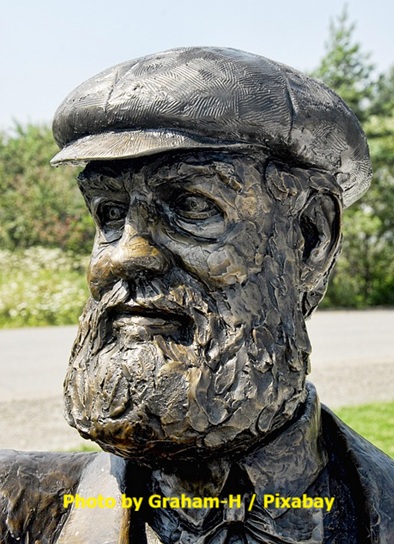
The photo depicts a bronze statue of a bearded man wearing a flat cap and a suit, likely representing Alexander Graham Bell. The statue has a textured, weathered appearance, with detailed facial features and clothing. It is set outdoors, with greenery and a road visible in the background. The image is credited to Graham-H on Pixabay.
The telephone stands as one of the most transformative inventions in human history, revolutionizing communication and shrinking the world in ways unimaginable to its creators. It allowed voices to travel across distances instantaneously, laying the groundwork for modern telecommunications, from landlines to smartphones. But the story of its invention is far from straightforward. While Alexander Graham Bell is universally credited with patenting the device in 1876, the path to that achievement was paved by earlier pioneers and marred by intense rivalries, legal battles, and accusations of theft. This article delves into the origins, key figures, and enduring debates surrounding the telephone’s birth.
Early precursors: from acoustic tubes to electrical dreams
The concept of transmitting sound over distances predates electricity. Ancient civilizations used speaking tubes—simple acoustic devices made of wood or metal—to communicate between rooms or ships. By the 19th century, inventors sought to harness electricity for this purpose, inspired by the rapid success of the telegraph, which sent coded messages via wires.
The first theoretical breakthrough came in 1854 from French inventor Charles Bourseul, who proposed using a membrane, likely envisioned as thin parchment or metal foil, to vibrate an electrical current, though he never built a working model. A decade later, in 1861, German physicist Johann Philipp Reis constructed a device called the “Reis telephone,” which used a sausage skin membrane to transmit musical tones and rudimentary speech, but it was unreliable for clear voice transmission. These early efforts highlighted the challenges: converting sound waves into electrical signals and back again without distortion.
Enter Antonio Meucci, an Italian inventor who fled political unrest in 1850 and settled in Staten Island, New York. Meucci claimed to have built a basic electromagnetic voice communicator as early as 1849 to aid his ailing wife, Ester, who was bedridden after a shipboard accident, though stronger evidence supports a working model by 1856, called the “teletrofono,” which used a copper foil membrane to transmit voice over wires between rooms in his home. In 1871, impoverished and facing health issues, Meucci filed a patent caveat (a preliminary notice of invention) for his “Sound Telegraph” with the U.S. Patent Office, but he couldn’t afford the $250 fee to convert it to a full patent. When he tried to renew it in 1874, he alleged that his models and notes, submitted to Western Union for funding, were lost, though no definitive proof confirms this loss. Meucci’s device used a copper strip and acid battery to produce electromagnetic vibrations, predating later designs. His story, one of perseverance amid poverty and language barriers, would fuel decades of debate.
Alexander Graham Bell: the reluctant inventor and lifelong polymath
Born on March 3, 1847, in Edinburgh, Scotland, Alexander Graham Bell—originally named simply Alexander Bell—grew up in a family deeply immersed in the study of speech and sound. His father, Alexander Melville Bell, was a renowned phonetician who developed “Visible Speech,” a system of graphic symbols to represent the positions of the vocal organs, aimed at teaching the deaf to speak. His mother, Eliza Grace Symonds Bell, was nearly deaf herself, and his grandfather had been an actor and elocutionist. These influences profoundly shaped young Bell, who received much of his education at home rather than in formal schools, fostering his inventive spirit from an early age. As a boy, Bell’s curiosity led to his first invention at age 12: a simple device made from a wooden paddle, nail brush, and whalebone to remove husks from wheat grain, inspired by a mill owned by a family friend. Tragically, both of his brothers died of tuberculosis in the 1860s, prompting the family to emigrate to Canada in 1870 for health reasons, where they settled in Brantford, Ontario. Bell moved to Boston the following year, teaching visible speech to deaf students at the Horace Mann School for the Deaf and later at the Clarke School for the Deaf in Northampton, Massachusetts. In 1873, he became a professor of vocal physiology and mechanics of speech at Boston University, where he met Mabel Gardiner Hubbard, a deaf student and daughter of his benefactor, Gardiner Greene Hubbard. They married in 1877, and Mabel’s hearing loss further fueled Bell’s passion for communication technologies.
Bell was no stranger to communication challenges. His mother and wife were deaf, and his family specialized in elocution and “visible speech”—a system of symbols to teach pronunciation to the hearing impaired, developed by Bell’s father. After moving to Canada in 1870 and then Boston in 1871, Bell taught at schools for the deaf while experimenting with harmonic telegraphs—devices to send multiple messages over one wire.
Bell’s breakthrough came in 1875. Working with assistant Thomas Watson, a skilled mechanic he met through his experiments, he refined a liquid transmitter that converted voice vibrations into electrical currents. On March 10, 1876, in a Boston attic, Bell spilled acid on his hand and famously called out, “Mr. Watson, come here—I want to see you,” the first intelligible sentence transmitted by telephone. (The often-misquoted “come here, I want you” actually occurred during the 1915 transcontinental call.) Bell’s patent application, filed on February 14, 1876, described an “apparatus for transmitting vocal or other sounds telegraphically.”
Bell’s motivation was personal and professional: improving telegraphy while aiding the deaf. But his success was not solitary. He drew on ideas from predecessors like Meucci and Reis, and his father-in-law, Gardiner Hubbard, funded the work and urged patenting to preempt rivals. Bell became a U.S. citizen in 1882 while retaining British subject status, and in 1885, he co-founded the American Telephone and Telegraph Company (AT&T), which grew into a telecommunications giant. However, Bell was not a shrewd businessman; by 1880, he largely delegated company affairs to others to focus on his diverse scientific pursuits.
Far from a one-hit wonder, Bell’s inventive genius spanned multiple fields. He refined Thomas Edison’s phonograph into the Graphophone in 1886, an improved wax-cylinder recording device that advanced sound reproduction. In 1880, he invented the photophone, which transmitted sound on a beam of light—a precursor to modern fiber optics and wireless communication. During the 1881 shooting of President James Garfield, Bell developed an early metal detector to locate the bullet, though it failed due to interference from the president’s bed frame. His interests extended to aviation; in 1907, he founded the Aerial Experiment Association, which built the first practical hydrofoil boat and contributed to early airplane designs, supporting pioneers like the Wright brothers. Bell also explored eugenics, studying hereditary deafness and advocating for oral education methods for the deaf. Some of his views, such as discouraging intermarriage among the deaf to prevent hereditary deafness, are now considered controversial and reflective of the era’s problematic eugenics movement. He held over 18 patents in his name and shared 12 more with collaborators, embodying a “unfettered” curiosity that ranged from genetics to marine engineering.
In 1890, Bell founded the American Association to Promote the Teaching of Speech to the Deaf (now the Alexander Graham Bell Association for the Deaf and Hard of Hearing), and he served as the first president of the National Geographic Society from 1898 to 1903, helping transform it into a global institution. He also co-founded Science magazine. In 1916, he was knighted by King George V as Sir Alexander Graham Bell. Bell spent his later years at his estate in Baddeck, Nova Scotia, where he conducted experiments on sheep breeding and tetrahedral kites. He died peacefully on August 2, 1922, at age 75 from diabetes complications. In a fitting tribute, telephone services worldwide paused for one minute of silence.
The patent drama: Bell vs. Elisha Gray
The most dramatic chapter unfolded on February 14, 1876, when Bell’s application arrived at the U.S. Patent Office in Washington, D.C., just hours before Elisha Gray’s. Gray, a prolific Ohio inventor and co-founder of Western Electric, filed a caveat for a similar device using a water-based microphone to transmit speech. Gray, focused on multiplex telegraphy for Western Union, had demonstrated tone transmission in 1874 but hadn’t prioritized voice until late 1875.
On March 7, 1876, Bell’s patent (No. 174,465) was granted, making him the official inventor. Controversy erupted immediately. Patent examiner Zenas Wilbur, reportedly an alcoholic paid by Hubbard, allegedly shared Gray’s caveat details with Bell’s team, allowing revisions that mirrored Gray’s design. Gray, unaware of the interference, didn’t contest it initially. Bell defended his patent in over 600 lawsuits, winning most, but suspicions of foul play lingered. As one historian noted, Bell benefited from being an outsider to telegraphy, unburdened by industry biases.
Legal battles and international recognition
The telephone’s patent sparked a flurry of litigation. Meucci sued Bell in 1885, claiming theft after sharing his lab space and ideas, but died in 1889 before resolution. Gray pursued claims but settled out of court. In 2002, the U.S. House of Representatives passed a resolution honoring Meucci’s “work in the invention of the telephone,” citing his 1860 demonstration and lost prototypes—though it was symbolic, not legally binding. Canada countered swiftly, with Parliament reaffirming Bell as the inventor, highlighting his Canadian roots in Brantford, Ontario. Italy, meanwhile, celebrates Meucci as the true pioneer, with museums dedicated to his legacy.
These disputes underscore a broader truth: invention is collaborative. Bell’s patent succeeded because he commercialized it effectively, founding the Bell Telephone Company (later AT&T) in 1877.
Impact and legacy
The telephone exploded in popularity. By 1880, over 60,000 were in use worldwide. It connected businesses, families, and nations, enabling the rise of switchboards, long-distance lines, and eventually the internet. Bell, knighted in 1916, went on to invent the photophone (light-based sound transmission) and advocate for aviation and deaf education.
Today, amid endless debates, Bell remains the name etched in history books—yet Meucci and Gray remind us that progress often builds on overlooked shoulders. As telecommunications evolve into 5G and beyond, the telephone’s story endures as a testament to human ingenuity and the messy reality of discovery. Who truly “invented” it? Perhaps the answer lies not in one name, but in the collective spark of many minds.