
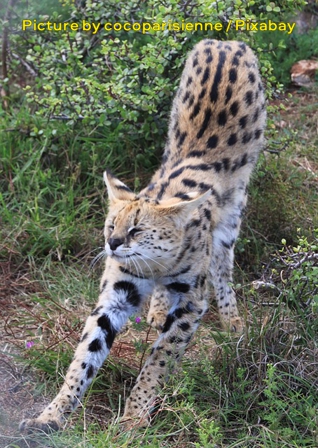
The Serval (Leptailurus serval) is a strikingly elegant wild cat native to sub-Saharan Africa, renowned for its slender build, long legs, and remarkable leaping ability. Often referred to as the “giraffe of cats” due to its elongated neck and legs, the Serval is a master of agility and precision in its natural habitat. This article explores the biology, behavior, and conservation status of this captivating cat.
Physical characteristics
The Serval is a medium-sized cat, typically weighing between 7 to 18 kg (15 to 40 lbs.) and standing about 40 to 60 cm (1’3″ to 2′) at the shoulder. Servals are 59 cm to 1 m (1’11″ to 3’3”) in length. The Serval’s most distinctive feature is its disproportionately long legs, the longest of any cat relative to its body size, which enable it to leap up to 3 meters (10 feet) vertically to catch prey. The Serval’s coat is a tawny yellow with bold black spots and stripes, providing excellent camouflage in the tall grasses of its habitat. Its large, oval-shaped ears are highly sensitive, capable of detecting the faintest sounds of prey, even underground.
| Class | Mammalia |
| Order | Carnivora |
| Family | Felidae |
| Genus | Leptailurus |
| Species | L. serval |
| Binomial Name | Leptailurus serval |
| Length | 59 cm-1 m (1’11″-3’3”) |
| Shoulder height | 40-60 cm (1’3″-2′) |
| Weight | 7-18 kg(15-40 lbs.) |
| IUCN Status | Least Concern |
Habitat and distribution
Servals thrive in a variety of habitats across sub-Saharan Africa, from savannas and grasslands to wetlands and marshes. They are particularly associated with areas near water sources, where tall grasses and reeds offer cover for hunting. Their range spans countries like Kenya, Tanzania, South Africa, Ethiopia, Uganda, and parts of West Africa, though they are absent from dense rainforests and arid deserts. Servals are highly adaptable, often found in human-modified landscapes like agricultural fields, provided there is sufficient cover and prey.
Behavior and hunting
Servals are solitary and primarily nocturnal, though they may be active during dawn and dusk (crepuscular). Their exceptional leaping ability and acute senses make them formidable hunters. Servals rely on their keen hearing to locate prey, such as rodents, birds, reptiles, and insects, often pouncing with pinpoint accuracy. Their hunting success rate is remarkably high, with studies suggesting they land successful kills in about 50% of attempts, far surpassing many other wild cats.
Unlike many felids, Servals are not strictly territorial. Their home ranges overlap, and they mark their areas with scent markings and vocalizations, including a distinctive high-pitched chirp. Servals are also known for their playful behavior, often batting at prey or objects with their paws, a trait that adds to their charismatic appeal.
Diet
The Serval’s diet is diverse, reflecting its opportunistic hunting style. Small mammals, particularly rodents, make up the bulk of their food, but they also prey on birds, snakes, lizards, and even small antelopes. Servals are known to eat fish and frogs in wetland areas, showcasing their adaptability. Their ability to leap high allows them to snatch birds in mid-flight, a feat few other predators can match.
Reproduction
Servals reach sexual maturity around 1 to 2 years of age. After a gestation period of approximately 65 to 75 days, females give birth to a litter of one to four kittens, typically in dense vegetation for protection. Newborn Serval kittens weigh between 250 to 450 grams (9 to 16 ounces) at birth. The mother raises the kittens alone, teaching them to hunt before they become independent at around 6 to 8 months. Kittens are born with a fuzzy coat and closed eyes, opening them after about two weeks.
Conservation status
The Serval is listed as Least Concern on the IUCN Red List, indicating a stable population across much of its range. However, localized threats exist, including habitat loss due to agriculture, human-wildlife conflict, and poaching for their pelts or for the pet trade. In some regions, Servals are hunted as pests due to occasional predation on poultry. Conservation efforts focus on protecting wetland habitats and mitigating human-wildlife conflict to ensure their populations remain stable.
Unique adaptations
The Serval’s unique adaptations make it a standout among wild cats. Its long legs and neck allow it to see over tall grasses, while its large ears detect the slightest movements of prey. The Serval’s pouncing technique is another marvel: it can leap vertically to snatch birds or horizontally to cover distances up to 3.6 meters (12 feet) in a single bound. Additionally, Servals have a flexible diet and habitat preference, enabling them to thrive in diverse environments.
Human interaction
Their striking appearance has made Servals a target for the exotic pet trade, though their wild nature makes them unsuitable as pets. Hybrid breeds, such as the Savannah Cat (a cross between a Serval and a domestic cat), have gained popularity, but ethical concerns surround their breeding and care.
Conclusion
The Serval is a testament to nature’s ingenuity, combining grace, athleticism, and adaptability into a single, captivating package. Its ability to thrive in varied environments, coupled with its extraordinary hunting prowess, makes it one of Africa’s most successful small predators. As human activities continue to encroach on their habitats, protecting the Serval’s natural environment is crucial to ensuring this remarkable cat continues to leap through the African savanna for generations to come.